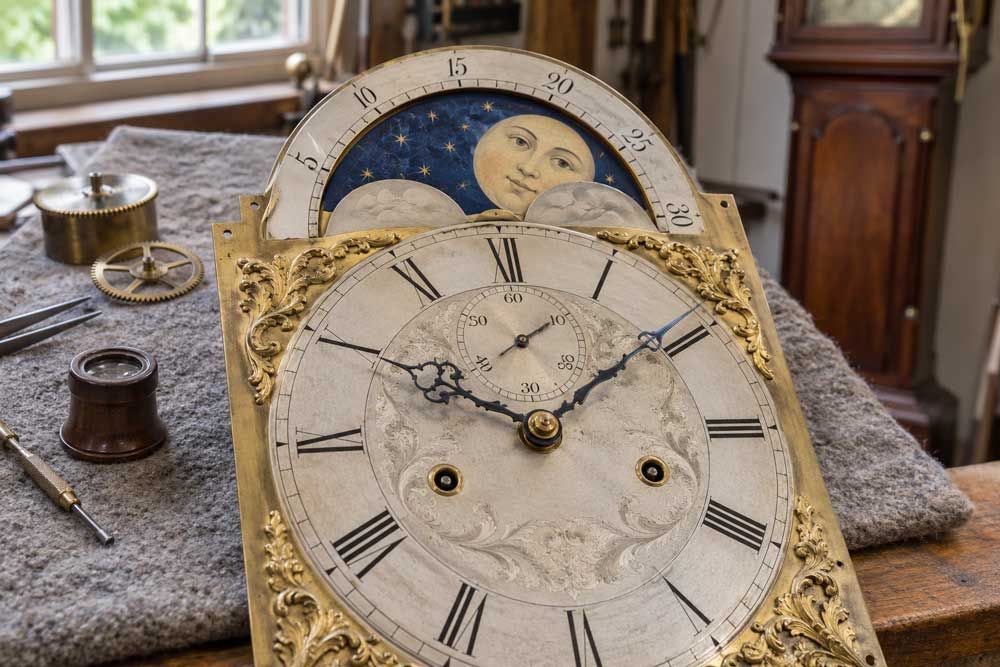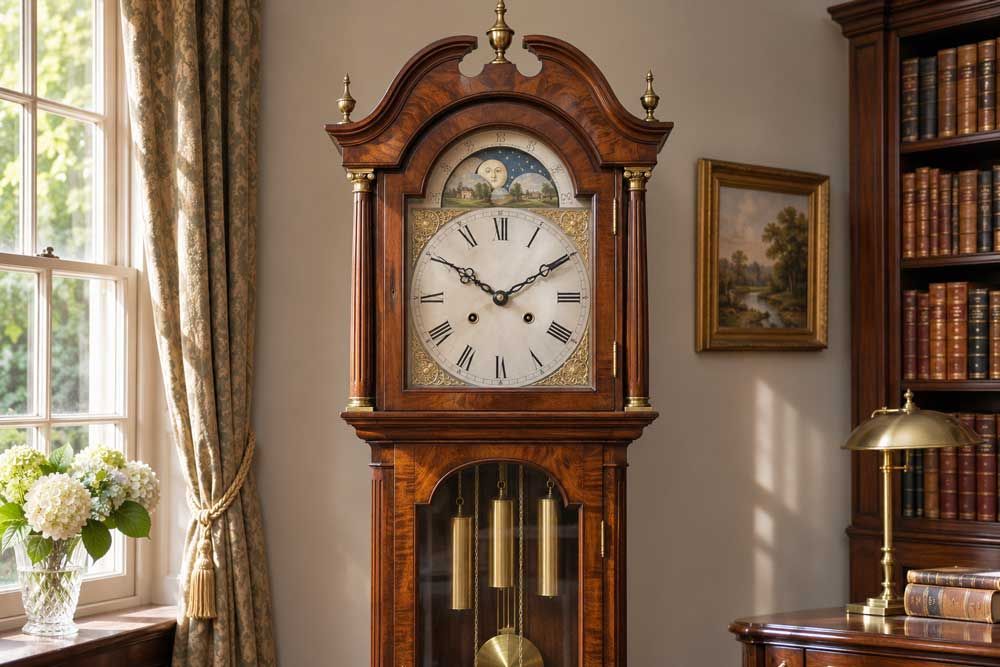
Why Your Howard Miller Grandfather Clock Stops After a Few Hours
The pendulum swings a few times after you set it, the chimes ring on the hour, and then, sometime in the night or the following afternoon, the timepiece goes silent. If you own a Howard Miller grandfather clock and this rhythm feels familiar, you are not dealing with a failing heirloom; you are dealing with a delicate instrument that responds to its physical environment in ways most families only notice when the quiet sets in.
This walkthrough examines the four most common external causes: improper leveling, an uneven pendulum beat, weight misalignment, and winding issues. It also explains when the care of your timepiece must be trusted to a workshop. Our goal is to offer a clear, methodical path from silence back to steady ticking, without risking damage to the delicate movement in the process.
Understanding Why Your Howard Miller Grandfather Clock Stops Running
A Howard Miller grandfather clock typically stops after a few hours due to an uneven pendulum beat, an unlevel case, misaligned weights, or dried-out internal lubricants. These factors disrupt the transfer of energy from the weights through the escapement mechanism, causing the pendulum to lose momentum and eventually stand still.
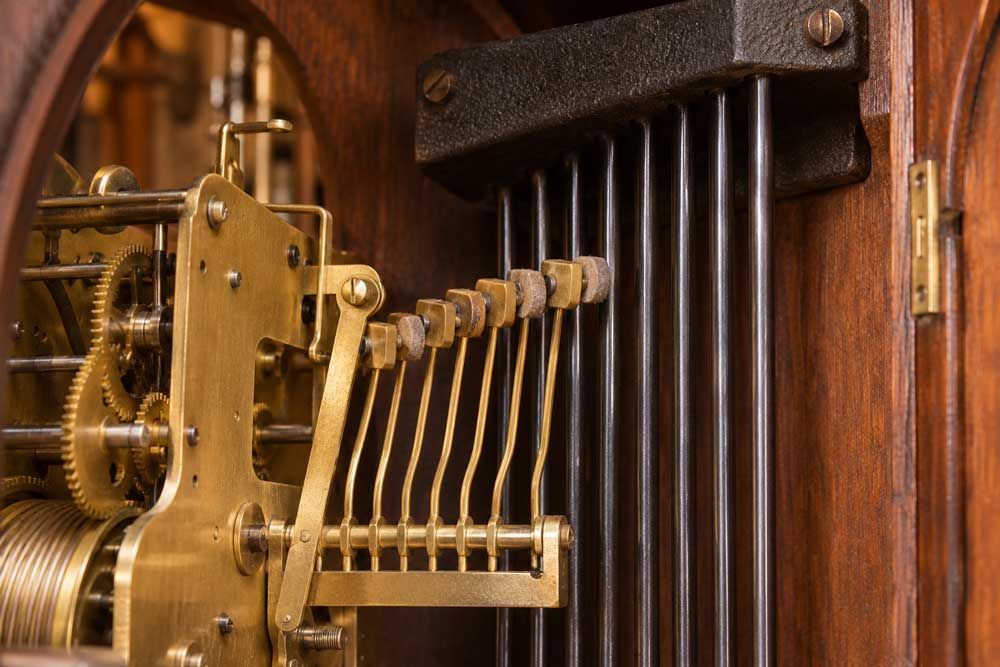
The three weights hanging inside the cabinet are the timepiece's power source. As they descend, they drive a gear train, a series of interlocking brass wheels, which transmits energy through the movement. The escapement, the mechanism responsible for the comforting tick-tock sound, regulates how that energy is released, allowing the pendulum to swing at a controlled, consistent rate. Every component in that chain depends on the one before it. One break halts everything.
What makes a grandfather clock more fragile than it looks is how little friction it can tolerate. The escapement is calibrated to release just enough energy to keep the pendulum swinging, and not much more. A slightly tilted floor, a microscopic accumulation of dust in the gear pivots, or a pendulum that rubs against the back of the case can drain that energy faster than the weights can replenish it. The timepiece does not fail dramatically; it simply winds down, often within a few hours of being set. It just stops.
One warning worth stating plainly: never apply WD-40 or any household lubricant to a grandfather timepiece's movement. These products attract dust and, over time, form an abrasive paste inside the pivot holes that grinds down the brass plates and steel arbors. The damage is cumulative and often irreversible without a full movement overhaul. Timepiece movements require specialized synthetic horological oils, applied in precise amounts to specific points: a job that belongs to a trained caretaker.
The First Step in Troubleshooting: How to Level a Grandfather Clock
To level a grandfather clock, adjust the threaded leveling feet under the corners of the wooden cabinet until the case is perfectly stable and plumb. Even a fraction of an inch of tilt can cause the pendulum to rub against the weights or the back of the case, stopping the timepiece within hours.
A grandfather clock must be level both front-to-back and side-to-side. When the cabinet leans in any direction, gravity pulls the pendulum off its natural arc, meaning it no longer swings freely through the center of the crutch, the metal rod connecting the movement to the pendulum. The pendulum may brush against the weights, the back panel, or the sides of the case, with each contact point stealing a small amount of energy from the swing until the timepiece stops entirely.
The leveling process requires patience but remains simple:
- Place a spirit level on top of the clock cabinet and check side-to-side alignment.
- Place the level against the side of the case to check front-to-back alignment.
- Use an open-ended wrench to turn the adjustable levelers located under the bottom corners of the base.
- Confirm that all four feet make solid, stable contact with the floor, eliminating any rocking; this is especially important on thick carpeting or uneven hardwood.
Homeowners in the Chicago metropolitan area face a particular challenge here. Seasonal humidity swings cause both wooden floors and clock cabinets to swell and contract across the year. A timepiece that was perfectly level in a humid August may be noticeably off-plumb by February, when forced-air heating pulls moisture from the wood. Checking the level seasonally, not just at installation, is a habit worth building.
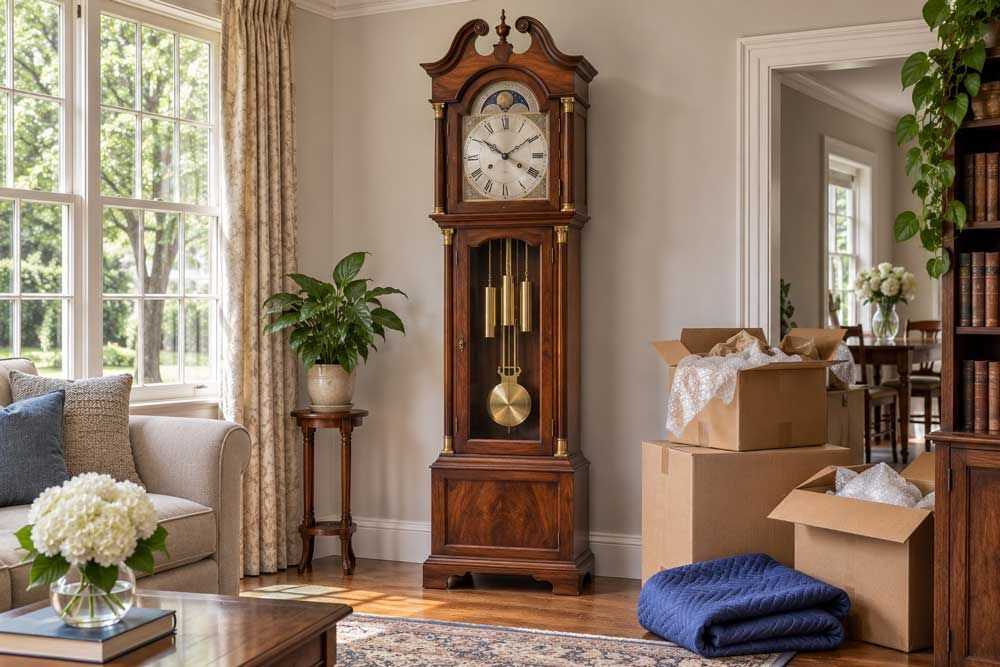
If your timepiece has recently been moved or if adjusting the leveling feet feels daunting, our fourth-generation family workshop handles the delicate calibration for you. We offer professional clock moving and setup services across northern Illinois, southern Wisconsin, and northern Indiana to ensure your heirloom is perfectly leveled and positioned for a lifetime of steady ticking.
How to Set Your Grandfather Clock in Beat
A grandfather timepiece is "in beat" when the tick and the tock are perfectly balanced in timing and volume. If the beat is uneven, sounding like a limping "tick...tock-tick...tock," the pendulum will lose energy and stop swinging after a few hours, even if the timepiece is perfectly level and the weights are fully wound.
The beat is the audible signature of the escapement. Each tick and each tock represents one tooth of the escape wheel being released by the pallet: the small forked component at the top of the pendulum rod, called the crutch. When the crutch is properly aligned with the movement, the escape wheel releases each tooth at equal intervals, producing a steady, metronomic rhythm. When the crutch is even slightly off-center, one side of the escapement releases its tooth faster than the other, creating that characteristic limp in the sound.
Listening is the primary assessment tool. Close your eyes and listen to the rhythm. Focus on the spacing. An even beat sounds like a metronome, with equal spacing between each tick and each tock. An uneven beat sounds rushed on one side and delayed on the other: the mechanical equivalent of a person walking with a slight hitch in their step.
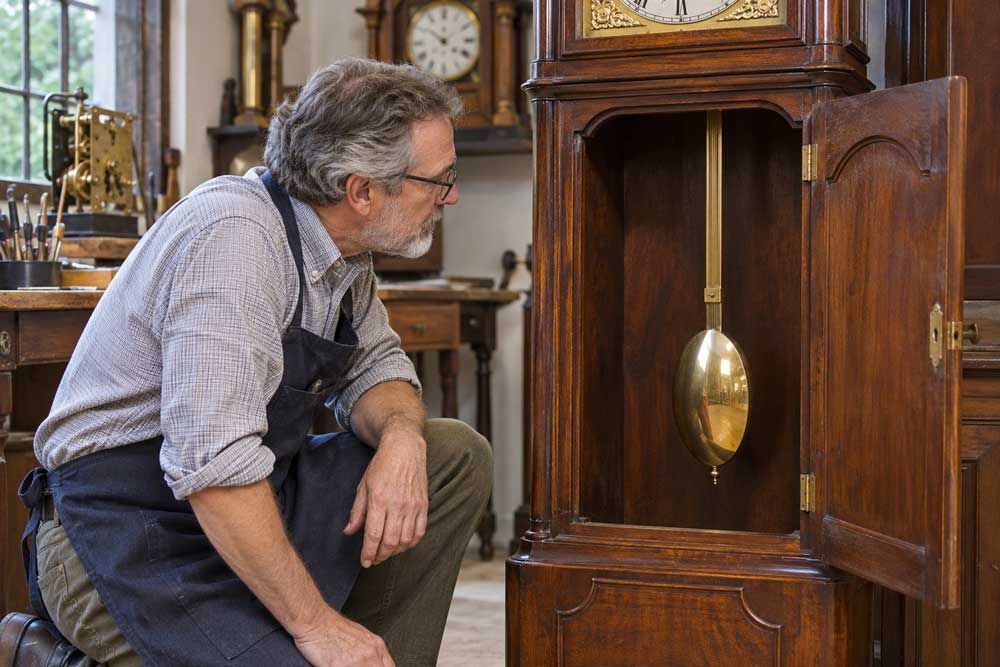
To correct it, carefully push the pendulum to one side and release it, listening closely to the rhythm that follows. If the beat is uneven, the crutch needs adjustment. On most Howard Miller models, this means shifting the top of the pendulum guide a small amount in the direction of the faster, shorter tick. Make the adjustment in small increments, listening after each one, until neither side sounds rushed. If the mechanism feels stiff or offers any resistance beyond the normal flex of the crutch, stop immediately: forcing a stiff crutch risks bending the verge, which requires professional disassembly to restore.
Verifying Weight Alignment and Winding Status
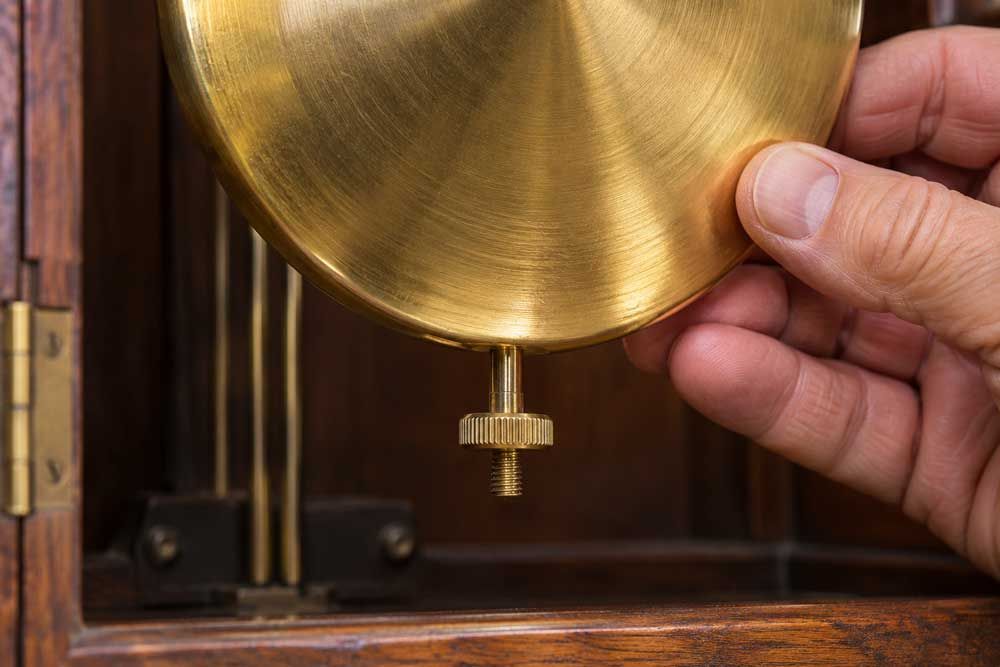
A Howard Miller grandfather timepiece will stop if its weights are hung in the wrong order or if they have run all the way down. The three weights are not substitutable; each must occupy its designated position (left, center, or right) to deliver the correct operating force to its corresponding gear train.
The three weights each power a separate function. Each has a role. The left weight drives the strike train, which controls the hourly count of the bell or gong. The center weight powers the time train, the mechanism that keeps the timepiece running and advances the hands. The right weight drives the chime train, which operates the heavier chime hammers and requires the most power of the three. Placing a lighter weight on the right side is one of the most common causes of a timepiece that runs for a few hours and then stops, because the chime train eventually stalls and locks the entire movement.
Most Howard Miller weights are marked at the bottom with "L," "C," and "R" from the perspective of someone facing the timepiece. If the markings have worn off or are unclear, the heaviest weight always belongs on the right. When hanging the weights, also verify that none of them are touching each other, brushing against the pendulum, or rubbing against the sides of the case as they drop: any contact point creates drag that compounds over hours of operation.
- Left weight: powers the strike train (hourly bell or gong count)
- Center weight: powers the time train (hand movement and clock operation)
- Right weight: powers the chime train; must be the heaviest of the three
Winding follows a similar logic of patience and restraint. Whether your timepiece uses a crank key or pull chains, the motion should be smooth and steady. Wind each weight fully, and stop the moment you feel resistance. Never force it. Forcing a wound-tight cable or chain risks snapping it, which is an avoidable and costly restoration.
Recognizing Internal Mechanical Resistance and Expired Lubrication
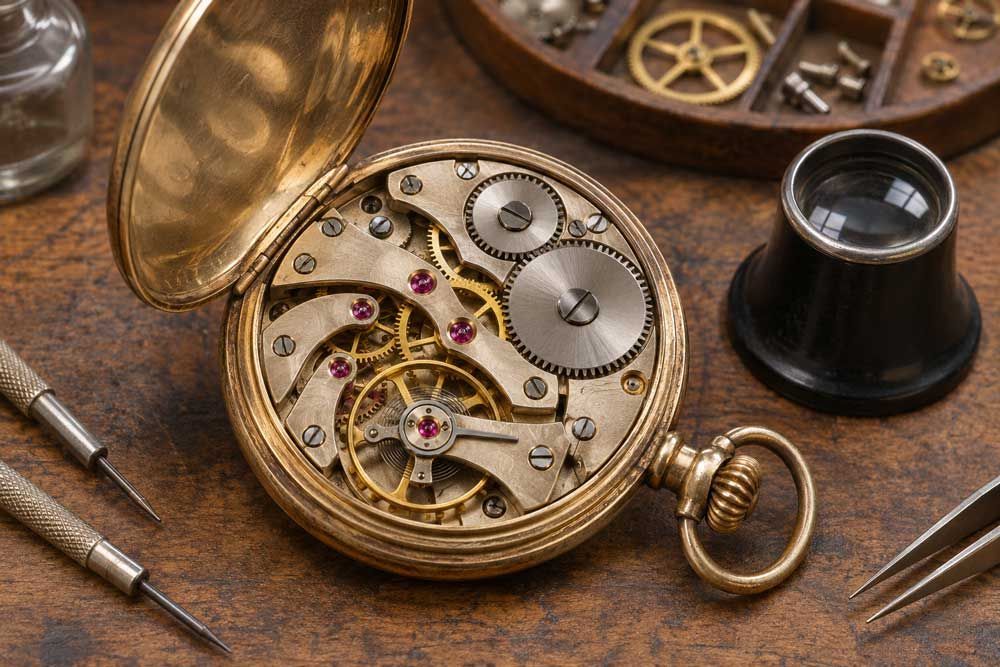
Internal mechanical resistance occurs when the specialized synthetic oil inside the timepiece movement dries out, thickens, or collects dust over time. This creates friction in the gear pivots that robs the timepiece of the power needed to keep the pendulum swinging, even when the timepiece is perfectly level, in beat, and fully wound.
Timepiece oil does not last indefinitely. Over several years, the protective lubricants in the pivot holes naturally degrade: they thin out, evaporate, or oxidize into a sticky residue. At that point, the pivots are running metal-on-metal inside their brass bushings. The friction generated is subtle at first, barely perceptible in the timepiece's behavior, but it accumulates. A movement that once ran effortlessly begins to labor, and the pendulum loses momentum faster than the weights can compensate.
The longer this goes unaddressed, the worse the structural damage becomes. Wear builds quickly. Dry pivots act like fine sandpaper against the brass plates, gradually enlarging the pivot holes, a condition called worn bushings. Once the holes are out of round, the gear train loses its precise alignment, and no amount of leveling or beat adjustment will restore consistent operation. Understanding the timepiece oil lifespan of your specific movement is one of the most critical factors in preserving it long-term.
Several indicators point to internal mechanical resistance rather than an external adjustment issue:
- The timepiece stops after a few hours despite being perfectly level and in beat, with fully wound weights.
- The weights are wound but do not descend at all over several days, suggesting the gear train has seized.
- The hands catch at the same position every hour, indicating a worn gear tooth or a jam in the chiming mechanism that triggers at that specific point.
- The movement produces a grinding or squeaking sound during operation: audible evidence of metal-on-metal friction inside the pivot holes.
When any of these symptoms appear, the appropriate response is to stop winding the timepiece and contact our workshop. Continuing to run a movement with dried-out oil accelerates wear on every component the pivots touch, turning a simple maintenance issue into a structural one.
Frequently Asked Questions About Grandfather Clock Troubleshooting
Why does my timepiece keep stopping at the same time?
If your grandfather timepiece stops at the exact same time every hour or twice a day, it typically indicates a physical obstruction. This is most often caused by the hands touching each other or rubbing against the dial glass. It can also point to a worn gear tooth or a jam in the chiming mechanism that triggers at that specific position in the movement's cycle.
Are Howard Miller grandfather timepieces worth anything?
Yes, Howard Miller grandfather timepieces hold significant sentimental and monetary value. While they generally decline from their original retail price, high-quality models with solid wood cases and triple-chime German movements remain highly valued family heirlooms. When properly maintained, they can last for generations, which makes the cost of regular preservation a reasonable investment compared to the cost of replacement.
How do you keep a grandfather timepiece running?
Wind the timepiece fully once a week, ensure the cabinet remains perfectly level on a stable surface, and keep it away from direct heat sources and drafty areas. Beyond the weekly routine, have the movement professionally cleaned and oiled every three to five years. That preservation interval is what separates a timepiece that runs for decades from one that develops progressive mechanical damage.
Why is my grandfather timepiece's pendulum not swinging?
A pendulum that refuses to swing usually means the timepiece is either severely out of level or completely out of beat. If the cabinet is tilted even slightly, the pendulum guide will rub against other components and kill the momentum within minutes. Ensure the case is plumb, then listen for a symmetrical tick-tock rhythm. If neither adjustment restores the swing, the issue is likely internal. Do not force it.
Can I oil my grandfather timepiece myself?
It is strongly discouraged. Timepiece movements require highly specialized synthetic horological oils applied in microscopic amounts to precise pivot points, not a general coating of the visible gears. Applying the wrong oil, or applying too much of the right one, will attract dust and create a destructive abrasive paste that ruins the movement from the inside out. This is one task where professional hands protect the timepiece.
Since 1917, four generations of the Matthiesen family have served as the trusted guardians of Chicagoland's most cherished timepieces. At Chicago Clock Company, Jason Matthiesen, Louie Matthiesen, and Conrad Utecht understand that your Howard Miller grandfather timepiece is not just a piece of furniture: it is a vessel for your family's story, carrying the memories of those who wound it before you. Whether your timepiece needs a simple adjustment, a thorough cleaning, or a complete mechanical restoration, our factory-authorized custodians treat every heirloom with the meticulous care and reverence it deserves.
To restore the silent heartbeat of your family heirloom, contact our main workshop at 630 986 9210 or visit us at 431 Ogden Avenue. You can also find our team in Orland Park at 14486 LaGrange Road (708-349-2565) and in Palatine at 1615 North Rand Road (847-359-5805). All locations are open Monday through Friday from 10 am to 6 pm and Saturdays from 10 am to 5 pm.