Why Is My Howard Miller Grandfather Clock Not Chiming?
If your Howard Miller grandfather clock has stopped chiming, the cause is usually a simple mechanical misalignment, such as an engaged silent lever, misplaced weights, or out-of-reach chime hammers. Most of these issues can be safely resolved at home with a few gentle adjustments. The process is straightforward.
At Chicago Clock Company, we have understood weight since 1917. We understand. Four generations of our family have spent over a century caring for these distinguished timepieces, learning their temperaments, reading their movements, and restoring their voices when they fall quiet. When a clock in your home stops chiming, we know the quiet anxiety that follows, and we know that the last thing you want is to cause further harm by reaching in without knowing what you are touching.
Is Your Howard Miller Grandfather Clock Silent? Quick Diagnostic Overview
If your Howard Miller grandfather clock is not chiming, the issue is typically caused by an engaged silent lever, misaligned weights, or out-of-reach chime hammers. For quartz models, a drop in battery voltage is the primary culprit. Most of these issues can be safely resolved at home without touching the delicate internal gearing. Start with the basics.
Howard Miller timepieces are engineered with precision-fitted gears designed to run for decades when properly maintained, where the gentle oils that once allowed the gears to dance must remain clean and fluid. The movement, the intricate mechanical heart of the clock, operates through a carefully balanced interplay of gravity, tension, and timing. Each component depends on the others, which is why a single small disruption, a weight hung slightly off-center, or a lever nudged during dusting, can silence the entire chime sequence without affecting the clock's ability to keep time.
These movements contain self-correcting sequences. The chime train is designed to work through its cycle and re-synchronize, but only if you allow it to do so without interference. Forcing a stuck lever, pushing a hammer back into place with too much pressure, or turning the hands backward are the actions most likely to turn a minor inconvenience into a costly mechanical repair. In our workshop, we know that patience is a vital preservation strategy.
The first and most critical step in any diagnosis is identifying whether your clock runs on a mechanical movement (cable-driven or chain-driven, powered by the gravitational descent of hanging weights) or a quartz movement (battery-powered, with an electronic oscillator regulating the timekeeping). The troubleshooting path diverges significantly depending on which system your clock uses. Before touching anything, take a moment to look through the side-access glass panels of the cabinet. If you see three hanging weights and a pendulum swinging in a steady arc, you have a mechanical movement. If the pendulum swings but there are no weights, or if the clock runs on batteries alone, you have a quartz system.
For issues that go beyond these external checks, such as internal wear, gummed lubricants, bent pivots, or a chime train that simply refuses to engage, our professional clock repair services exist precisely for those moments. Chicago Clock Company operates a complete on-premises repair department staffed by factory-authorized technicians who approach each clock as an heirloom to be preserved with meticulous care. When the situation calls for a trained hand rather than a careful owner, that resource is available to you.
Common Causes of Grandfather Clock Chiming Failure
Chiming failures in Howard Miller clocks usually stem from simple minor oversights. Check these first. The most common causes include the chime selector lever being bumped into the "Silent" position, the weights being hung in the incorrect order, or the chime hammers being bent slightly out of alignment with the rods.
Seasonal changes affect mechanical clocks more than most owners realize. In the Chicago region, where humidity swings between dry winters and humid summers, the wooden cabinet of a grandfather clock expands and contracts with the seasons. Over time, this subtle movement can shift the alignment of internal components, particularly the chime hammers, which are mounted on delicate brass wires and require only a fraction of an inch of clearance to function correctly. A hammer that was perfectly positioned in October may be pressing lightly against its rod by February, muffling or entirely blocking the strike.
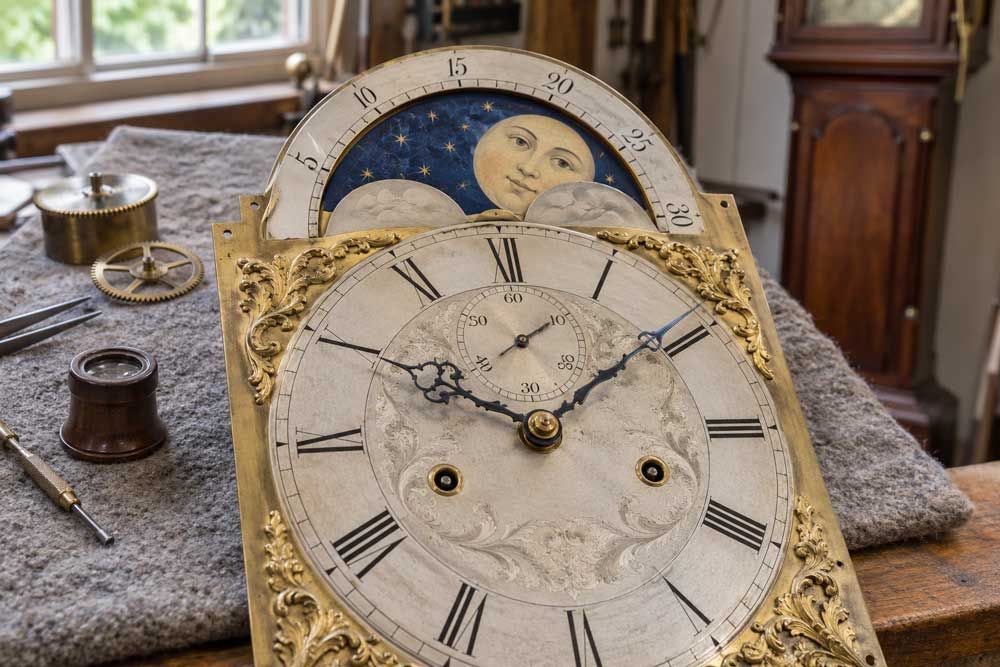
Routine cleaning is another surprisingly common trigger for chiming failures. The act of dusting the cabinet, polishing the glass panels, or wiping down the dial face can accidentally nudge the chime selector lever out of its notch. This lever, typically located near the three o'clock or nine o'clock position on the dial, clicks into distinct positions for different chime melodies and for silence. If it rests between notches rather than firmly in one, the chime train receives an ambiguous signal and will often disengage entirely.
A subtler problem occurs when the lever is moved while the clock is actively in the middle of a chime cycle. The mechanism can lock in a partially engaged state, what technicians sometimes call a chime silent lever lockup, where the lever feels stuck, and neither position seems to work. This represents the movement waiting to complete its sequence before accepting a new instruction, rather than a sign of damage. Forcing the lever in this state is where real damage begins.
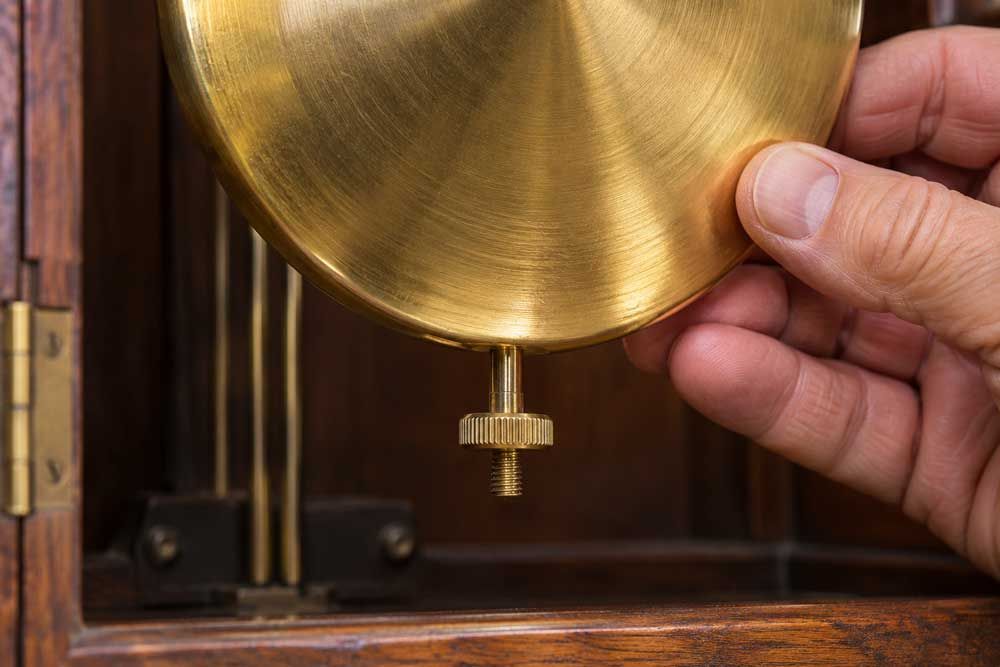
On mechanical movements, the clock weights serve a function that is easy to underestimate. Each of the three weights powers a different train within the movement: one for timekeeping, one for the chime sequence, and one for the hour strike. They are not interchangeable; they differ in mass to provide the precise gravitational pull each train requires. If a weight is hung on the wrong side, or if one weight has descended too far and run out of travel, the chime train will lose power and fall silent before the timekeeping train does. This is why a clock can continue ticking accurately while producing no chimes at all.
Here is a quick checklist of the most common culprits to inspect before attempting any adjustment:
- The Chime Selector Lever: Confirm it is fully clicked into a chime melody position, such as Westminster, and not resting in "Silent" or caught between notches. A lever that feels loose or springy when you touch it has likely slipped out of its detent.
- Weight Placement: Verify that all three weights are hanging on their correct sides (left, center, and right). Each weight differs in mass to power a different part of the movement, and placing them in the wrong positions will cause the chime or strike train to run out of energy prematurely.
- Pendulum Alignment: Check that the pendulum is swinging in a smooth, even arc and that the clock is sitting perfectly level on the floor. A clock that leans even slightly will develop an uneven tick, a sound technicians describe as "out of beat," which can eventually cause the movement to stop.
- Chime Hammers: Open the side-access panels and inspect the small leather-tipped hammers. Each should sit approximately 1/8 inch away from its corresponding chime rod, close enough to strike cleanly but never resting against it.
- Battery-Operated Models: Check whether the batteries are fresh. Low voltage will halt the chime function before it stops the clock hands; thus, a clock that keeps time but produces no chimes is often simply running on depleted batteries.
If your clock is located in northern Illinois, southern Wisconsin, or northern Indiana and you would rather not risk disturbing the mechanism further, our family-trained craftsmen can come directly to your home. Schedule your in-home grandfather clock repair today, or call us at 630 986 9210 to speak with our family directly. Transporting a grandfather clock through traffic, with its pendulum, weights, and delicate movement, carries a real risk of structural and mechanical damage that an in-home visit eliminates entirely.
Step-by-Step Troubleshooting Guide for Howard Miller Clocks
To safely troubleshoot your clock, start by verifying the chime lever position, then check that the weights are fully wound and hanging straight. Next, inspect the chime hammers for clearance, and if you own a quartz model, replace the batteries. Always move the hands forward, never backward, during any adjustments. This is crucial.
Adjusting the Chime Selector Lever
The chime selector lever is typically positioned on the dial face, near the three o'clock or nine o'clock position depending on your specific Howard Miller model. It clicks into distinct detents for each available melody, commonly Westminster, Whittington, and St. Michael, as well as a "Silent" position. When you touch it, you should feel a firm, positive click as it moves from one position to another.
If the lever feels stiff or locked when you try to move it, do not apply additional force. A locked lever almost always means the movement is mid-cycle, working through a chime or strike sequence that has not yet completed. Waiting fifteen to twenty minutes will typically allow the mechanism to clear itself and accept the lever's new position. The correct moment to shift the lever is when the minute hand is at least fifteen minutes away from the next quarter-hour strike point; moving it while the clock is approaching a strike can trigger the lockup again.
Once the lever moves freely, press it with steady, firm pressure into your preferred melody position until you feel it click. A lever that rests between positions will produce inconsistent or absent chimes even when everything else is functioning correctly.
Inspecting Weights and Chime Hammers
On a mechanical Howard Miller movement, all three weights must be wound fully to the top of their travel to provide consistent gravitational pull throughout the week. Use your winding key and turn with steady, even pressure. If a weight feels unusually light when you wind it, or if the cable or chain appears to be sitting off its pulley, stop and examine the pulley alignment before continuing. Cables and chains that overlap on their pulleys can bind the movement and, in the worst cases, allow a weight to drop suddenly, risking damage to both the family timepiece and the cabinet floor.
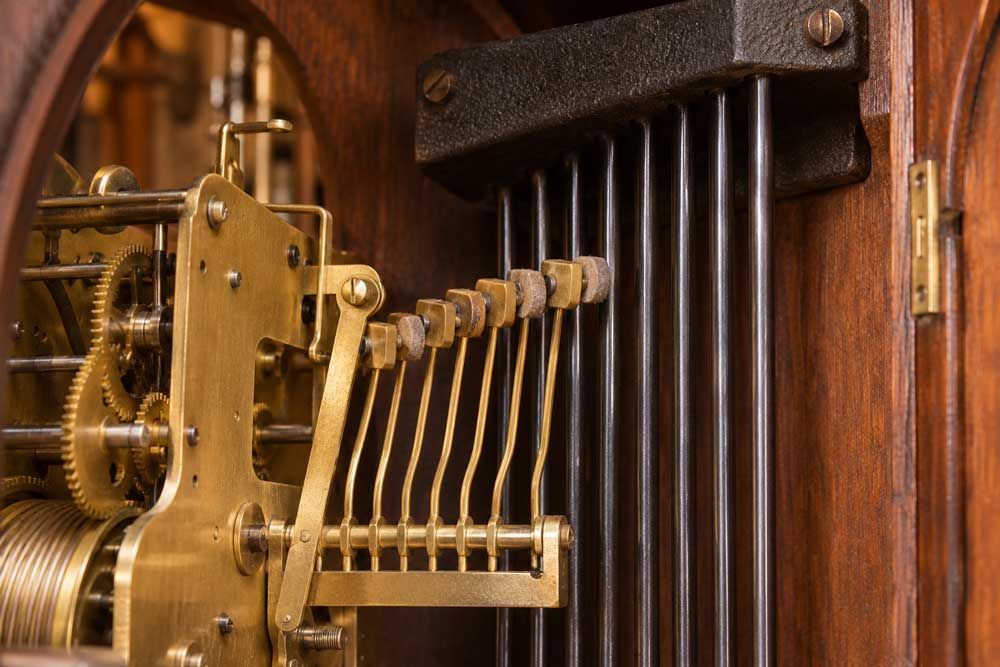
To inspect the chime hammers, open the side-access wood panels or the rear door of the cabinet. The hammers are small, leather-tipped strikers mounted on slender brass wires, arranged in a row above the chime rods. Each hammer should move freely on its pivot, swinging forward to strike the rod and returning cleanly to its rest position. If a hammer feels stiff or sticky when you softly test its pivot with a fingertip, it may be binding on a bent wire or a dried lubricant deposit. A hammer that presses constantly against its rod, rather than resting just clear of it, will dampen the tone and eventually prevent the strike entirely. When adjusting the wire, use the lightest possible touch; brass work-hardens quickly and can crack if bent back and forth repeatedly.
Here is the full diagnostic sequence, performed in order:
- Verify and Reset the Chime Lever: Move the selector lever to "Silent," wait ten minutes, then carefully move it back to "Westminster" or your preferred melody. Confirm it clicks firmly into place before proceeding.
- Check and Wind the Weights: Use your winding key to wind all three weights fully to the top of their travel. Confirm that the cables or chains are seated properly on their pulleys and are not overlapping or twisted.
- Inspect Hammer Clearance: Examine each chime hammer. If any are touching their rods, carefully bend the brass hammer wire back until a small gap, roughly the width of a cardboard matchbook, exists between the hammer head and the rod.
- Synchronize the Chime Cycle: If the clock is striking the wrong hour, wait for it to strike, count the number of strikes, then carefully move the hour hand to point to that number. From there, advance the minute hand forward to the correct time, pausing at each quarter-hour to let the chime sequence complete before continuing.
- Power Cycle the Quartz Movement: For quartz models, remove the old batteries, wipe the brass battery contacts with a dry cloth to remove any corrosion or oxidation, and insert fresh, high-quality alkaline batteries.
Maintenance and Professional Care for Your Timepiece
Regular professional preservation is essential to preserve the life of a grandfather clock. It requires patience. Over time, the gentle oils that once allowed the gears to dance grow thick with age, attracting dust and creating an abrasive paste that wears down delicate brass gears. Professional cleaning and oiling prevent mechanical failures and keep the chimes sounding rich and resonant.
Think of a mechanical grandfather clock movement the way you might think of a living organism that never sleeps. Every gear, every pivot, and every escape wheel is in constant motion, and the thin film of oil protecting those surfaces is the only thing standing between smooth operation and rapid wear. As clock oil ages, it loses viscosity and begins to attract airborne dust and microscopic debris. What was once a lubricant becomes an abrasive compound, one that slowly grinds away at the soft brass pivot holes and gear teeth that took a skilled craftsman hours to fit. The chime train, which requires more power to operate than the timekeeping train, is typically the first to show the effects of this degradation. A timepiece that chimes weakly, inconsistently, or not at all is often telling you that its movement needs cleaning and fresh lubrication before the wear becomes irreversible.
Proactive care is always less expensive and less invasive than reactive restoration. A movement that is cleaned and oiled before serious wear develops can run reliably for another generation. A movement that has been allowed to run dry until the pivot holes wear oval requires far more extensive work, including rebushing, polishing, and in some cases replacing components that are no longer manufactured. The difference between those two outcomes is often nothing more than attentive, timely preservation. For an heirloom clock that carries family history, that distinction matters enormously.
There is also a quieter argument for regular professional care, one that goes beyond mechanics. Bringing a horologist into your home to service your clock is an act of stewardship, a deliberate choice to resist the throwaway mentality that treats everything as replaceable. A Howard Miller grandfather clock, properly preserved, can outlast the people who first wound it. Passing one down in full working order, its chimes still clear and resonant, is a form of inheritance that no amount of money can replicate.
To speak with our family about a preservation visit, or to bring your clock into our care in person, visit either of our Chicago Clock Company showrooms:
Orland Park 14486 LaGrange Road Phone: 708-349-2565 Mon-Fri: 10 am - 6 pm, Sat: 10 am - 5 pm
Palatine: 1615 North Rand Road. Phone: 847-359-5805 Mon-Fri: 10 am - 6 pm, Sat: 10 am - 5 pm
Our main office is located at 431 Ogden Avenue; reach us directly at 630 986 9210. For those who prefer to have their timepiece preserved without moving it, we offer professional grandfather clock delivery and setup at $125, and standard clock delivery at $25, ensuring every timepiece arrives and departs perfectly level and calibrated.
When to Call a Professional Horologist
You should call a professional horologist if your clock remains silent after basic troubleshooting, if the weights refuse to drop, if you hear grinding noises, or if the chime lever is completely locked. These symptoms point to internal wear or mechanical damage that requires specialized tools to address safely. Do not wait.
Some conditions are simply beyond the reach of careful owner preservation, and recognizing them early prevents a manageable issue from requiring a full restoration. The following signs indicate that the movement needs professional attention:
- Worn Pivot Holes: The brass plates that hold the gear pivots have worn from round to oval over years of use, causing the gears to bind intermittently. The chime train stalls at unpredictable points in its cycle, and no amount of lever adjustment or winding will resolve it.
- Broken Click Springs: The winding mechanism slips or feels completely loose when you attempt to wind the weights, indicating that the spring that locks the ratchet wheel has fractured.
- Gummy or Blackened Oil: Visible dark residue on the gears and pivots inside the movement signals that the lubricant has degraded into an abrasive paste. The movement may still run, but every hour it does so accelerates the wear on its brass components.
- Bent Gear Teeth: The clock hands continue to move, but the chime sequence stalls at the exact same minute every hour, a reliable indicator that a specific gear tooth is damaged and the train is catching on the same point in each rotation.
- A frayed weight cable or a chain that keeps slipping off its sprocket deserves immediate attention, not because the chimes are at stake, but because a weight that falls freely inside the cabinet can cause serious structural damage to the case and the movement beneath it.
None of these conditions require you to move your clock. Our factory-authorized horologists carry the tools, replacement components, and diagnostic experience to perform complete restorations directly in your home. They arrive prepared to assess the full condition of the movement, not just the immediate issue, and they work with the same careful attention that has defined our family's approach to horology since 1917. Every home we enter, we treat with the same respect we bring to the heirlooms inside it.
Frequently Asked Questions About Grandfather Clock Chimes
How do I reset the chimes on my grandfather clock if they are striking the wrong hour?To reset the chimes, wait for the clock to strike and count the number of strikes carefully. Carefully grasp the hour hand, the short hand, and rotate it to point directly to the number that was struck. Once the hour hand matches the strike count, use the minute hand to advance the clock forward to the correct time, pausing at each quarter-hour to allow the chime sequence to complete fully before continuing.
Are Howard Miller grandfather clocks worth repairing and restoring?Yes, without doubt. Howard Miller grandfather clocks are high-quality, heirloom-grade timepieces built with hand-assembled movements designed for longevity. Their value is both sentimental and mechanical; the intricate gearing inside a well-preserved Howard Miller movement represents craftsmanship that simply is not produced at that level in modern mass-market goods. Restoring one preserves a piece of family history and ensures that future generations inherit a fully functional timepiece rather than a decorative cabinet. For most owners, the investment in restoration is a fraction of what the clock represents in legacy value.
How do I wind a pendulum clock safely without damaging the springs or cables?Insert the winding key into the winding holes on the dial face and turn with a steady, even pressure, clockwise or counter-clockwise depending on how your specific movement's pulleys are oriented. The critical rule is to stop the moment you feel firm resistance. Do not attempt to squeeze out one more turn past that point; the resistance is the movement telling you the weight has reached the top of its travel. Forcing past it strains the cables and, on spring-driven movements, risks snapping the mainspring.
My Westminster chimes are out of sync with the hands. How can I fix this?Move the minute hand forward past the next quarter-hour strike point and allow the chime sequence to play completely before advancing the hand again. Repeat this process, moving fifteen minutes at a time and waiting for each sequence to finish, until the chime pattern automatically self-corrects and aligns with the hand position. Most Howard Miller movements will synchronize within one full hour of this process. The key is patience: advancing the hand before the current sequence finishes will compound the misalignment rather than correct it.
Is it okay to move my grandfather clock hands backward when adjusting for daylight saving time?No. Moving the hands of a mechanical grandfather clock backward can damage the delicate gear teeth and throw the chime synchronization mechanism out of alignment in ways that are not always immediately apparent. The correct approach is always to advance the hands forward, moving the minute hand ahead by eleven hours rather than back by one. Pause at each hour and quarter-hour to let the clock chime before continuing. It takes longer, but it is the only safe method for a mechanical movement.
Take a moment, if you can, to simply listen to your family timepiece. The measured tick of a well-regulated mechanical movement is one of the few sounds in a modern home that connects the present to something genuinely old, a rhythm that has not changed since the craftsmen who built these movements first set them in motion. If your Howard Miller grandfather clock has gone quiet, the silence is worth addressing, but it rarely signals catastrophe. Most chiming failures have simple, accessible causes, and the careful checks described in this guide resolve the majority of them without any tools and without opening the movement.
If your clock remains silent after working through these steps, you do not have to face the problem alone. Chicago Clock Company has been the trusted guardian of Chicagoland's family timepieces since 1917, and our fourth-generation family is ready to help, whether that means answering a question over the phone, walking you through a diagnosis at one of our showrooms, or sending a master horologist directly to your home.
Schedule your in-home grandfather clock repair today and let us restore the warm, resonant Westminster chimes that belong in your home. Call us at 630 986 9210 to speak directly with Jason Matthiesen, Louie Matthiesen, or Conrad Utecht, our family, at your service. You can also visit us in person at our Orland Park showroom at 14486 LaGrange Road or our Palatine showroom at 1615 North Rand Road, where we have been welcoming Chicagoland families through our doors since 1917.