Howard Miller Moon Dial Not Working: Causes and Fixes
In a world where most things are built to be thrown away, choosing to preserve an heirloom is a quiet act of devotion. If your Howard Miller heirloom grandfather clock's moon dial has gone still, you are already doing the right thing by pausing before touching it. That instinct to stop and understand the mechanical soul of your timepiece is exactly what protects a delicate, irreplaceable movement from permanent harm. Diagnosing a stalled lunar disk requires understanding the boundary between a careful owner's adjustment and a restoration that requires a trained horologist's hands.
Understanding the Grandfather Clock Moon Dial Mechanism
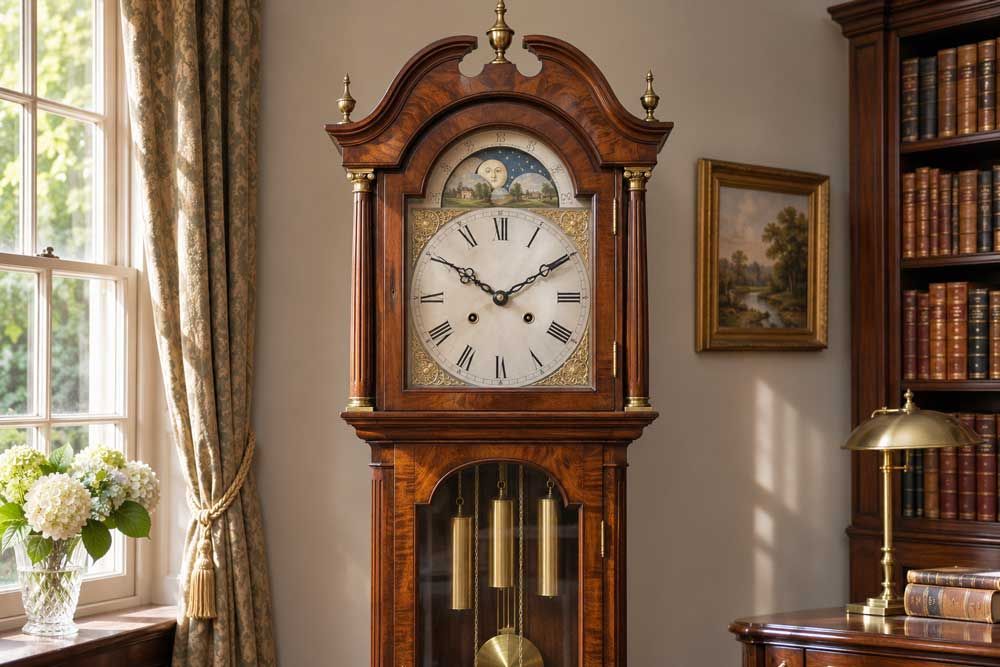
The moon phase dial on a Howard Miller heirloom grandfather clock tracks the 29.5-day lunar cycle by advancing incrementally through the timepiece's gear train. It moves in barely perceptible daily steps, driven by the same mechanical energy that powers the timekeeping movement. Because the advancement is so incremental, a stalled dial often goes unnoticed for days before the owner realizes something has changed. The moon stops.
The Mechanical Heartbeat of the Lunar Cycle
The lunar disk does not move continuously. It advances in a single, small step once every 24 hours, driven by the timepiece's automatic gear train rather than by any independent motor. That gear train draws its energy from the descending weights, and the energy passes through a carefully calibrated sequence of wheels and pinions before reaching the moon dial assembly at the top of the timepiece's hood. Each daily increment is so slight that watching the dial in real time reveals nothing; the movement is almost geological in its deliberateness.
What makes this mechanism genuinely elegant, and genuinely vulnerable, is the precision of that calibration. The gear train is tuned to complete one full lunar revolution in approximately 29.5 days, matching the synodic month with mechanical fidelity. That kind of accuracy across a month-long cycle depends on every component in the chain maintaining its proper tension and alignment. A single worn tooth, a microscopic accumulation of dried lubricant, or a slightly bent lever can interrupt the sequence entirely. Because the movement is so slow, the failure can be invisible until the dial has been frozen for a week or more.
For many families, the moon dial carries a significance that goes beyond mechanical curiosity. It is not just a clock; it is a vessel for memory. It holds history. Grandparents who set it decades ago, children who grew up watching the painted lunar face drift across the arch of the timepiece: that slow, faithful progression is woven into the texture of household memory. When it stops, the loss feels disproportionate to the size of the mechanism causing it. We restore the gentle chime and the quiet movement that have marked Sunday mornings and holiday gatherings in your family for decades, ensuring this connection remains unbroken.
Defining Key Horological Components
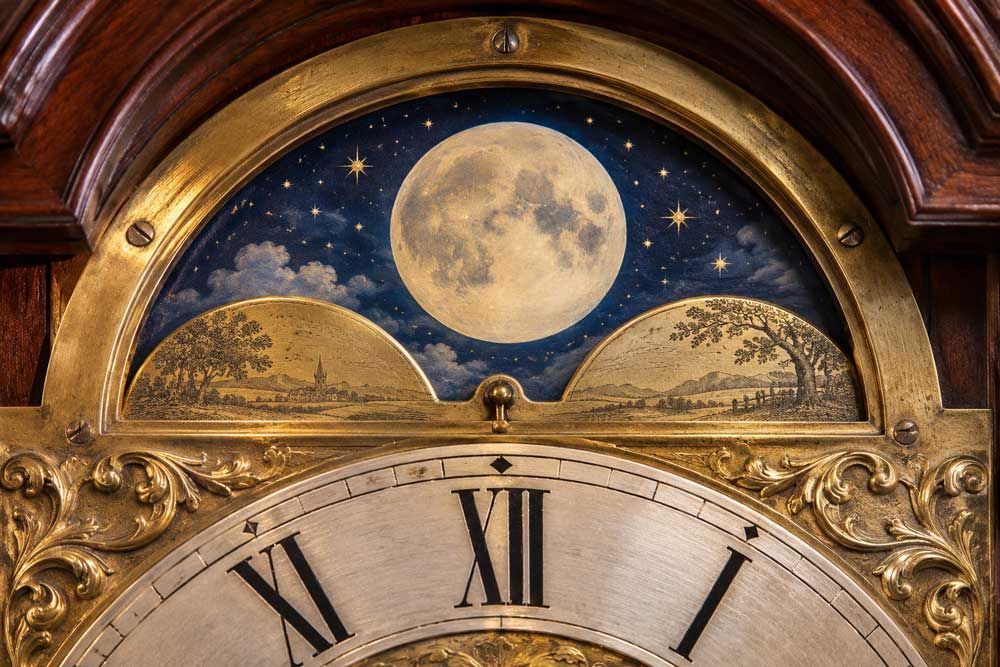
The moon phase dial is the painted or engraved rotating disk mounted in the arch of the timepiece's hood, depicting the lunar surface against a starfield. Its position relative to a fixed aperture in the dial plate shows the current phase: new moon, waxing crescent, full moon, waning gibbous, at any given moment.
Beneath that disk, the click spring acts as a ratchet, allowing the dial to advance in one direction only and preventing it from drifting backward under its own weight or vibration. When the click spring is functioning correctly, each daily advancement produces a faint, satisfying click. When it loses tension or bends out of position, the dial either slips freely or refuses to advance at all.
The advancement gear is the component that converts the timepiece's timekeeping energy into the slow rotation of the lunar disk. It connects directly to the main movement and drives the dial forward in those precise daily increments. The number of teeth calibrated to the lunar cycle is a specific engineering detail of the movement design. Referring to it simply as the precise tooth count calibrated to the 29.5-day cycle is accurate enough for diagnostic purposes, and fabricating a number here would be worse than leaving it unspecified.
Why Is My Clock Moon Dial Stuck? Common Causes of a Stalled Lunar Disk
A Howard Miller heirloom grandfather clock moon dial typically stalls for one of three reasons: a physical obstruction or debris in the gear teeth, a click spring that has slipped out of alignment or lost tension, or an attempt to manually rotate the dial during the hours when the timepiece's automatic advancement mechanism is actively engaged. Each cause produces a different symptom and demands a different response. Each requires careful diagnosis.
Physical Obstructions and Gear Misalignment
Heirloom grandfather clocks gather airborne dust at a rate that surprises most owners. Over years of operation, fine particulate matter settles into the gear teeth of the moon dial assembly, and old lubricants, applied during a service visit years or decades prior, gradually congeal into a gummy residue that resists movement. Neither process is dramatic, but together they can generate enough friction to overcome the modest driving force available to the lunar mechanism, which operates at the far end of the gear train where mechanical advantage is lowest.
The dial can also slip off its track. This causes binding. The lunar disk rides on a set of pins or a channel designed to keep it concentric with the dial plate aperture. If the timepiece has been moved, jarred, or if a previous adjustment was made with too much lateral pressure, the disk can shift slightly off its seating. Once misaligned, even a small amount of eccentricity creates binding that the advancement gear cannot overcome. A click spring that has been bent, even fractionally, compounds this, because it may press against the disk unevenly, creating drag in one arc of the rotation while leaving the rest of the cycle relatively free.
The Danger of Manual Adjustments During Lock-Out Hours
The timepiece's automatic advancement mechanism engages during the critical late-evening to early-morning hours to advance the lunar disk for the following day. During this window, the gear train is under load, and the advancement arm is in physical contact with the dial. Attempting to rotate the dial manually while this engagement is active is the single most common cause of serious moon dial damage, and it is entirely avoidable.
When an owner forces the dial against an engaged gear train, the mechanical resistance they feel is the advancement arm or the gear teeth themselves bearing the full torque of the manual push. The components involved are slender and precisely formed; they are not designed to absorb that kind of lateral stress. They break easily. The result is typically a bent advancement arm, stripped gear teeth, or a fractured click spring, any of which converts a simple misalignment problem into a movement repair requiring disassembly.
The three causes worth keeping in mind before attempting any adjustment:
- Improper manual adjustment: Forcing the dial when the internal gears are locked during the automatic advancement cycle.
- Physical misalignment: The dial slipping off its track or the click spring losing tension, creating binding that prevents smooth forward movement.
- Debris and dried lubricants: Accumulated dust or congealed oil gumming up the delicate gear teeth and generating friction the advancement gear cannot overcome.
Bring Your Timepiece In for a Complimentary Evaluation
For timepieces that are small enough to transport safely, our craftsmen at both Chicago Clock Company showroom locations can assess the moon dial mechanism on the spot: no appointment necessary, no waiting.
- Orland Park: 14486 LaGrange Road, 708-349-2565, Mon-Fri: 10 am - 6 pm, Sat: 10 am - 5 pm
- Palatine: 1615 North Rand Road, 847-359-5805, Mon-Fri: 10 am - 6 pm, Sat: 10 am - 5 pm
- Main Line: 630 986 9210
Howard Miller Moon Dial Adjustment Guide: How to Safely Set the Moon Phase
To safely set the moon phase on a Howard Miller heirloom grandfather clock, first calculate the current lunar day by finding the date of the last full moon and counting forward. Then wait until midday, when the automatic advancement mechanism is fully disengaged, and use a soft, gloved fingertip to rotate the dial clockwise in small increments. Stop the moment you feel any resistance.
Calculating the Lunar Cycle and Timing the Adjustment
Calculating the lunar day requires only a brief look at the calendar. Find the date of the most recent full moon using a printed calendar or any reliable online lunar calendar, then count the number of days that have passed since that date. That number is your current lunar day within the 29.5-day cycle. The full moon position on the dial, typically the painted moon centered in the arch aperture, is your reference point, and you advance the dial clockwise from there to match the elapsed days.
Timing matters as much as the calculation itself. Do not rush. The safest window for manual adjustment is midday, when the timepiece's automatic advancement mechanism has completed its engagement from the previous night and has not yet begun preparing for the next cycle. Adjustments made during the critical late-evening to early-morning hours risk catching the gear train mid-engagement, which is precisely the scenario that bends advancement arms and strips gear teeth. If you are uncertain whether the mechanism is disengaged, waiting until noon is a reliable default.
Applying Light Physical Pressure to the Dial
The physical act of advancing the dial requires less force than most owners expect. A soft, gloved fingertip, or a clean microfiber cloth wrapped around a finger, placed at the edge of the lunar disk and pressed with light pressure in the clockwise direction is adequate. The dial should move with almost no resistance, advancing in small, audible clicks as the click spring engages each tooth of the advancement gear.
Any resistance beyond that faint clicking sensation is a signal to stop immediately. Resistance means either that the gears are still engaged, that the dial is misaligned on its track, or that a component within the mechanism is already compromised. Continuing to push against that resistance will not free the dial; it will only deepen the problem. Stop immediately. Tools, screwdrivers, and pencil erasers have no place in this process; the force they allow far exceeds what the mechanism can safely absorb.
To adjust the dial, follow these steps in sequence:
- Calculate the lunar day: Find the date of the last full moon and count the days elapsed to determine your current position in the 29.5-day cycle.
- Verify the safe zone: Confirm you are adjusting during safe daylight hours, with midday being the most reliable window.
- Apply light pressure: Use a soft, gloved finger to rotate the dial clockwise in small increments. Stop immediately if you feel any resistance beyond the normal click of the advancement mechanism.
Troubleshooting Moon Dial on Grandfather Clock: When to Seek Professional Restoration
Professional restoration becomes necessary when the moon dial remains stuck after confirming safe adjustment hours and checking for obvious misalignment, when the dial spins freely without clicking, when visible damage is present on the disk or surrounding components, or when any manual adjustment attempt produces grinding or scraping sounds from within the movement. At that point, the problem is internal and requires disassembly.
Identifying Deep Mechanical Failures
A dial that holds its position but refuses to advance over multiple days, despite the timepiece running correctly, points to a failure in the advancement gear or the delicate tension spring that governs the click mechanism. These components sit within the movement itself, not on the accessible surface of the dial plate, and diagnosing them accurately requires removing the hood and inspecting the gear train under magnification. The specific horological designation of the spring or lever involved varies by movement manufacturer and model; referring to it as the delicate tension spring is accurate for general purposes, but a trained horologist will identify the precise component by direct examination rather than by name alone.
A bent advancement arm is a subtler failure. It is hard to spot. The arm may still make contact with the dial on each cycle but fail to generate enough forward force to overcome even minor friction. The dial advances unpredictably, moving some days and skipping others, before eventually stalling entirely. Stripped gear teeth produce a different symptom: the advancement mechanism completes its cycle, but the dial does not move at all because there is no longer a tooth for the arm to push against. Both conditions are repairable by a skilled horologist, but neither is accessible to a careful owner working without specialized tools.
The Risks of DIY Mechanical Overhauls
Attempting to remove the moon dial or access the movement at home introduces risks that overshadow the original problem. Heirloom grandfather clock movements are assembled under controlled conditions with calibrated tools; the tolerances involved are measured in fractions of a millimeter. Removing the dial plate without the correct support fixtures can allow the gear train to shift, displacing components that took hours to position correctly during the original assembly. Heirloom grandfather clocks are also acutely sensitive to being moved: the pendulum suspension, the crutch, and the beat adjustment are all disturbed by transport or tilting, and a movement that was running well before a DIY attempt may need a full re-regulation afterward.
Professional restoration preserves the timepiece's mechanical integrity and, where applicable, its warranty coverage. More practically, it preserves the timepiece itself: a Howard Miller heirloom grandfather clock is not a commodity that can be replaced with an equivalent unit. The movement, the case, and the accumulated patina of decades of family ownership are singular.
Schedule In-Home Restoration: No Transport Required
Our certified horologists, Jason Matthiesen, Louie Matthiesen, and Conrad Utecht, provide mobile, on-site diagnostics and repair across the entire Chicago metropolitan area. Your timepiece stays exactly where it belongs while we work. We come to you. To schedule in-home grandfather clock repair, call us at 630 986 9210.
Howard Miller Grandfather Clock Maintenance Tips for Long-Term Precision
The most effective maintenance for a Howard Miller heirloom grandfather clock's moon dial is maintaining the health of the entire movement. Professional oiling every three to five years, consistent weight winding, and keeping the glass door closed against dust accumulation will collectively extend the service life of the lunar mechanism far beyond what any reactive repair schedule can achieve.
Routine Care for the Delicate Movement
The heart of your timepiece deserves the same care you would give any treasured heirloom: hand-oiled gears that have kept families on schedule for generations. Clock oil deteriorates over time regardless of whether the movement is running. It must be replaced. After three to five years, lubricants that were applied during a service visit begin to oxidize and thicken, generating the same congealed-oil friction that contributes to moon dial stalls. A professional oiling service, which involves cleaning the old lubricant from every pivot point and applying fresh oil in the correct viscosity for each component, resets that degradation clock entirely. Skipping this interval does not save money; it accelerates wear on the gear teeth and pivot holes, turning a routine service into a more involved restoration.
Winding the weights on a consistent schedule matters more than most owners realize. An underwound timepiece runs with reduced driving force, and the moon dial mechanism, sitting at the far end of the gear train, is the first component to feel that deficit. The weights should be wound before they descend to within a few inches of the bottom of the case, not after the timepiece has already slowed or stopped.
Preserving Legacy and Irreplaceable Memories
Chicago Clock Company has served Chicagoland's timepiece owners since 1917, across four generations of family ownership. That continuity is not accidental to the quality of the work; it reflects a philosophy of custodianship rather than transaction. A Howard Miller heirloom grandfather clock that has stood in a family's home for forty or fifty years carries a history that no replacement can replicate, and the approach to maintaining it should reflect that weight.
- Regular professional oiling: Every three to five years to keep the delicate movement lubricated and prevent the congealed-oil friction that stalls the moon dial.
- Dust prevention: Keeping the glass door closed to protect the gear teeth and pivot points from airborne debris that accumulates invisibly over months and years.
- Proper winding: Ensuring the weights are wound consistently, before they descend too far, to maintain the steady driving force the gear train requires to advance the lunar disk reliably.
Routine maintenance preserves more than mechanical function. It protects memories. Every service visit, every careful oiling, every meticulous regulation, extends the life of an object that holds birthdays, anniversaries, and ordinary Tuesday mornings that have since become irreplaceable. The timepiece that chimed when a grandparent was still alive, that marked the hours of a child's first years at home: that is what a properly maintained movement protects. Mechanical precision and sentimental value are not separate concerns in an heirloom grandfather clock; they are the same concern expressed in different registers.
Frequently Asked Questions About Howard Miller Clock Moon Dial Repair
Why is my Howard Miller grandfather clock moon dial not moving at all?
The moon dial advances only once every 24 hours in an increment so small it is invisible in real time. If the dial shows no movement over several consecutive days while the timepiece is running correctly, the advancement gear may be worn, the delicate tension spring may have slipped out of alignment, or dried lubricant may be generating enough friction to prevent the mechanism from completing its daily cycle. A professional inspection is the safest next step.
Can I turn the moon dial backward if I overshoot the current phase?
Turning the moon dial backward is not safe and risks damaging the click spring or stripping the gear teeth, which are designed to accept force in one direction only. If you advance the dial past the correct phase, continue rotating it clockwise through the remainder of the 29.5-day cycle until you arrive at the correct position again. The extra rotation takes only a few minutes and causes no harm to the mechanism.
What is the lock-out period during which I should not adjust the moon dial?
The timepiece's automatic advancement mechanism engages during the critical late-evening to early-morning hours to advance the lunar disk for the following day. During this window, the advancement arm is in physical contact with the dial and the gear train is under load. Manual rotation during this period forces the dial against an engaged mechanism, which can bend the advancement arm, fracture the delicate tension spring, or strip the gear teeth, converting a simple misalignment into a movement repair.
How do I know if my clock's moon dial gears are stripped?
A stripped gear or broken click spring typically produces one of two symptoms. The dial may spin freely in either direction with no resistance and no clicking sound, indicating that the click spring is no longer engaging the gear teeth. Alternatively, the dial may feel loose and fail to hold its position between adjustments, drifting slightly from where it was set. Either symptom warrants professional restoration rather than further manual adjustment.
Is a broken moon dial worth restoring on an older Howard Miller clock?
For a timepiece that has served as a family heirloom, restoring every functioning element maintains both its historical integrity and its sentimental completeness. A moon dial that has tracked lunar cycles through decades of family life is not a cosmetic feature: it is part of the timepiece's identity. Our master horologists approach every restoration with the same reverence they bring to the movement itself, treating the repair as an act of preservation rather than a mechanical transaction.
Chicago Clock Company has been the trusted guardian of Chicagoland's timepieces since 1917, and that four-generation continuity shapes every interaction we have with a timepiece that matters to someone. Whether your Howard Miller moon dial needs a careful manual reset, a professional oiling to free a gummed gear train, or a full movement restoration to address a bent advancement arm or stripped teeth, the approach is the same: unhurried, precise, and oriented entirely toward preserving what the timepiece means to the family that owns it. Your heirloom deserves that kind of attention, and we are here to provide it.
Contact Chicago Clock Company
Schedule your in-home grandfather clock repair or visit one of our showrooms for expert advice from our certified horologists.
- Main Line: 630 986 9210
- Main Address: 431 Ogden Avenue
- Orland Park Showroom: 14486 LaGrange Road, 708-349-2565, Mon-Fri: 10 am - 6 pm, Sat: 10 am - 5 pm
- Palatine Showroom: 1615 North Rand Road, 847-359-5805, Mon-Fri: 10 am - 6 pm, Sat: 10 am - 5 pm