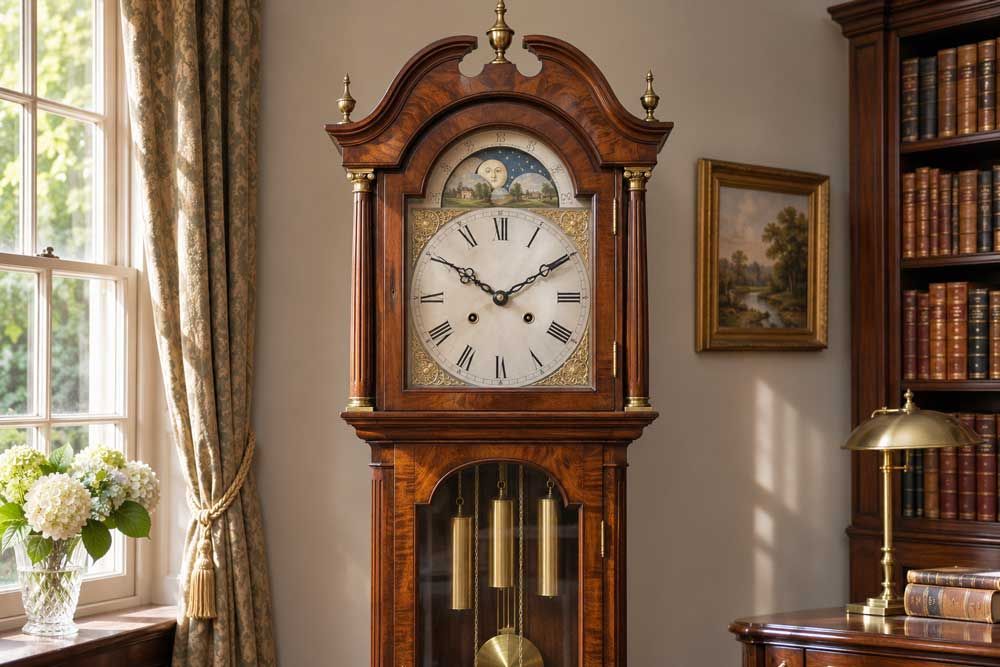
Howard Miller Grandfather Clock Night Shut-Off Not Working
When a Howard Miller grandfather clock chimes through the night or remains silent all day, the issue is almost always a simple 12-hour synchronization error, a stiffened shut-off lever, or a depleted battery in quartz models. There is a quiet worry that comes with lying awake at 2:00 AM while your family treasure fills the house with its full Westminster chime sequence. Or the opposite: standing in your living room at noon, watching the hands sweep past twelve in complete silence, wondering whether something has gone wrong with a timepiece your family has treasured for decades. Either way, the concern that follows is rarely just about the internal workings. It is about legacy. It is about the object itself: what it represents, who wound it before you did, and whether you are about to make things worse by touching it.
Understanding the Nighttime Shut-Off Mechanism on Your Heirloom Timepiece
The night shut-off feature on a Howard Miller heirloom clock is designed to silence the chimes during late-evening and early-morning hours, letting your household sleep undisturbed. When it stops working correctly, chiming through the night or staying silent all day, the cause is almost always either a misaligned AM/PM cycle, a stiffened lever, or a power issue in quartz models.
The nighttime shut-off serves as a mechanical or electronic guardian of your home's quiet hours. On mechanical movements, a small lever, typically positioned near the 3 or 9 o'clock position on the dial surround, physically engages a blocking arm that prevents the chime hammers from striking the tone rods during the designated quiet window. When you slide that lever to the "Night" or "Auto" position, you are directing the clock's own internal gear logic to decide when silence is appropriate. The timepiece reads its own position in the 12-hour cycle and acts accordingly.
That internal logic, however, only knows whether it is in the first or second half of a 12-hour rotation. It has no awareness of whether those hours correspond to your actual daytime or nighttime. When the AM and PM halves fall out of alignment with the real world, which happens more easily than most owners expect, the timepiece silences itself precisely when you want to hear it and chimes freely while the house is asleep.
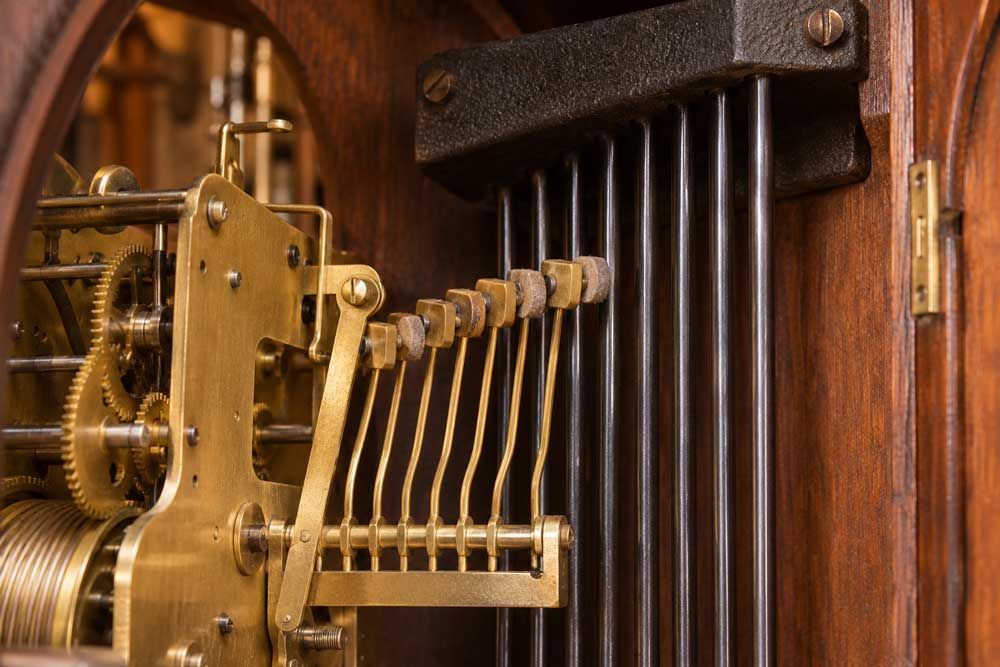
Mechanical movements accomplish this through a layered interplay of lifting pins, cam wheels, and a strike release lever. As the minute hand completes each rotation, a series of pins on the count wheel lifts the release arm at the correct intervals, allowing the hammers to fall. During the nighttime phase, a separate cam, driven by the same gear train, rotates into a position that blocks this release entirely. The whole system depends on gravity, tension, and the precise geometry of brass components that have been machined to tolerances measured in fractions of a millimeter. When everything is clean, properly lubricated, and correctly synchronized, the mechanism is remarkably reliable. When any one of those conditions slips, the quiet hours disappear. Silence is lost.
Quartz Howard Miller movements handle the same function differently. Rather than relying on physical cams and lifting pins, they use either a pre-programmed microprocessor or a light sensor to determine when to suppress the chime signal. The electronic silencing circuit receives its cue from the movement's internal clock, which is driven by battery voltage. This means the night shut-off on a quartz model is only as reliable as the batteries powering it. A fresh set of high-quality alkaline cells is not optional maintenance; it is the foundation the entire silencing feature rests on. Beyond battery health, the initial time-setting sequence matters enormously; setting a quartz movement to the wrong hour during setup can lock the AM/PM logic into an inverted state from the very first day.
The AM/PM Synchronization Issue: Why Your Clock Chimes at Night
A grandfather clock chiming at night while staying silent during the day is almost always the result of a 12-hour synchronization error. The timepiece's internal strike mechanism believes 2:00 PM is 2:00 AM, so it silences itself through your waking hours and chimes freely while you sleep. Correcting this requires advancing the hands forward, never backward, through a full 12-hour cycle.
The internal gears of a mechanical grandfather clock do not distinguish between morning and afternoon by reading a calendar or sensing ambient light. They simply count rotations of the gear train. If the movement was set with the hands positioned at the wrong point in the 12-hour cycle, such as during a move, after a power interruption in a quartz model, or after the timepiece was allowed to run down completely, the AM and PM phases swap. From that moment forward, the night silencer activates at noon and releases at midnight, which is precisely the opposite of what you need.
A common impulse when discovering this problem is to spin the hands backward to quickly reach the correct time. On a mechanical movement, this is one of the most damaging things you can do. The lifting pins that trigger the chime sequence are designed to engage in one direction only. Reversing the minute hand can bend those pins, jam the strike release, or cause the count wheel to skip positions, compounding a simple synchronization problem into a genuine mechanical restoration. The only safe direction for the minute hand on a mechanical grandfather clock is clockwise, advancing forward through each quarter-hour position and pausing long enough for the chime to complete its full sequence before continuing.
To correct the AM/PM synchronization, begin by advancing the minute hand clockwise until the timepiece strikes 12:00. Listen closely to the movement. What do you hear? If the soft chime fills the room fully at noon, it is currently in its daytime phase. If it remains silent at what should be noon, the movement has entered its nighttime phase and believes it is midnight. Once you know which phase the timepiece occupies, you can advance the hands through the remaining hours, pausing at each quarter-hour, until you reach the correct current time, accounting for the 12-hour offset if necessary. This patient craftsmanship is the only method that respects the movement's internal logic.
- Move the minute hand clockwise, pausing at each quarter-hour mark to allow the chime sequence to complete fully before advancing further. Never rush this step: forcing the hand past an unfinished chime can damage the lifting pins.
- Continue advancing past 12:00 until you reach the correct current time. If the timepiece was chiming during daytime hours before you began, account for the 12-hour offset by advancing through a full additional rotation.
- If the hour strike count does not match the position of the hour hand after synchronization, carefully reposition the hour hand independently, as most Howard Miller models allow the hour hand to be moved without engaging the chime train, or consult your movement's manual for the correct alignment procedure.
- Allow the timepiece to run for a full 24 hours and observe whether the quiet hours now align with your actual nighttime. If the chimes still activate at the wrong time after one complete cycle, the lever itself or the count wheel may require professional attention.
If you prefer not to risk adjusting these delicate gears yourself, our family at Chicago Clock Company is here to help. We receive your timepiece as if it were being placed into our hands by your grandfather himself. We invite you to schedule an in-home heirloom clock restoration service. Our master horologists will travel directly to your home, ensuring your cherished timepiece is calibrated with meticulous care right where it stands.
Troubleshooting a Sticky or Malfunctioning Night Shut-Off Lever
A sticky or completely unresponsive night shut-off lever is most often caused by accumulated dust, dried-out lubricants, or physical misalignment of the lever arm. These conditions prevent the lever from sliding cleanly between its "Chime" and "Silent" positions, which means the mechanical block that suppresses the chime hammers either never engages or never releases.
Grandfather clocks are far more sensitive to their environment than most owners realize. In the Chicago area, the indoor climate swings dramatically between seasons: the humid air rolling off the lakefront in July gives way to the parched, artificially heated air of a January interior. That cycle of expansion and contraction affects every wooden surface in the cabinet, but it also affects the thin film of oil that keeps the lever slides and pivot points moving freely. Old lubricants that were applied years ago absorb moisture during humid months and then dry into a gummy residue as the air dries out in winter. Over time, that residue thickens into something closer to varnish than oil, and a lever that once slid effortlessly begins to resist, then sticks, then stops moving entirely.
The inclination in that situation is to reach for whatever lubricant is available, such as a household spray, a general-purpose penetrating oil, or anything to free the mechanism. Resist that impulse. It ruins delicate gears. Products like WD-40 are petroleum-based solvents that will temporarily dissolve the old residue but leave behind their own oily film, which attracts dust and eventually creates a paste far more damaging than what you started with. Brass components require specialized, high-viscosity clock oils applied in precise, minimal quantities to specific pivot points. Using the wrong product on a grandfather clock movement is one of the most common causes of accelerated wear that horologists encounter.
A master horologist approaching this problem will first disassemble the relevant section of the movement to access the lever arm and its slide channel. We carefully unwrap the layers of time, attending to each gear the way a conservator tends to a piece of history, cleaning the old lubricant away entirely using appropriate solvents, inspecting the lever for physical bending or wear, and applying fresh clock oil to the pivot points and slide surfaces. This is not a lengthy process when performed by someone familiar with the movement, but it requires the right tools and the right materials. To prevent these delicate components from seizing, regular clock maintenance and lubrication are essential. Our fourth-generation family business has practiced the art of restoration since 1917, ensuring your heirloom's heartbeat remains steady and silent when it should be.
Several signs suggest the lever or movement has moved beyond what a careful owner can address at home:
- The shut-off lever feels completely locked or offers significant resistance when moved, even after patient, careful pressure.
- The lever moves freely between positions, but the chimes continue to play at all hours without any dampening, indicating the blocking arm has become disconnected from the lever mechanism.
- The chime hammers appear frozen in an upward or downward position, refusing to strike the tone rods regardless of the lever setting.
- The timepiece has not received professional lubrication or cleaning in several years, meaning the entire movement, not just the lever, is likely operating on degraded oil throughout.
"An heirloom clock is more than a mechanical assembly of brass and wood; it is the steady, comforting heartbeat of a home, carrying the memories of generations. Caring for it is not just about restoration; it is about preserving a legacy." : Chicago Clock Company
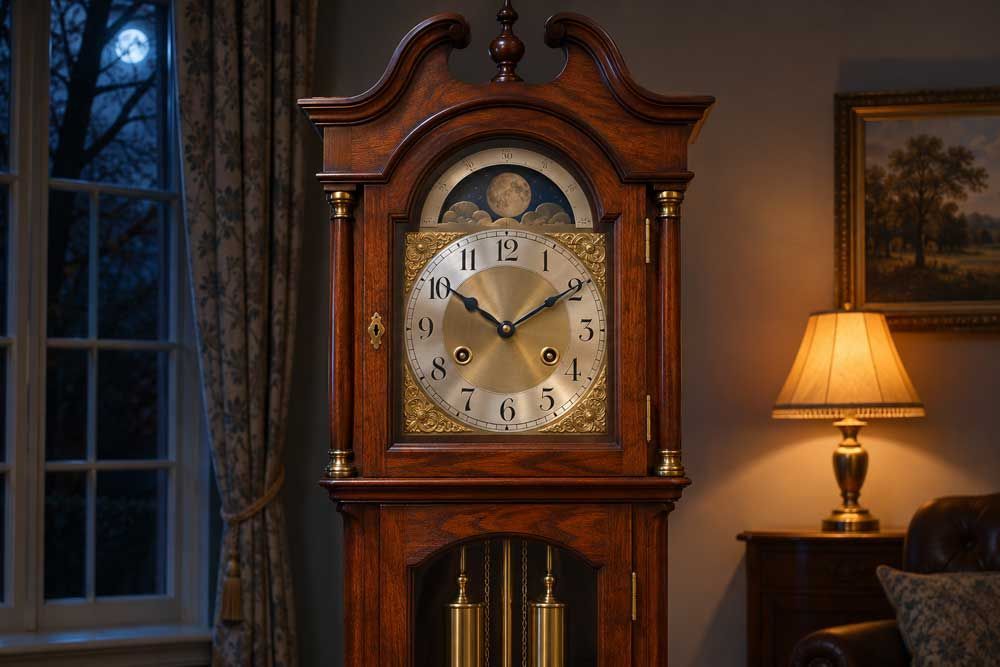
Weight Distribution and Its Impact on the Chime Mechanism
Improper weight distribution can rob the chime mechanism of the power it needs to operate correctly. If the weights have been placed on the wrong hooks, such as during a move, a cleaning, or a chain adjustment, the chime may fail to trigger, fail to silence on schedule, or stop altogether, even when the time train continues running.
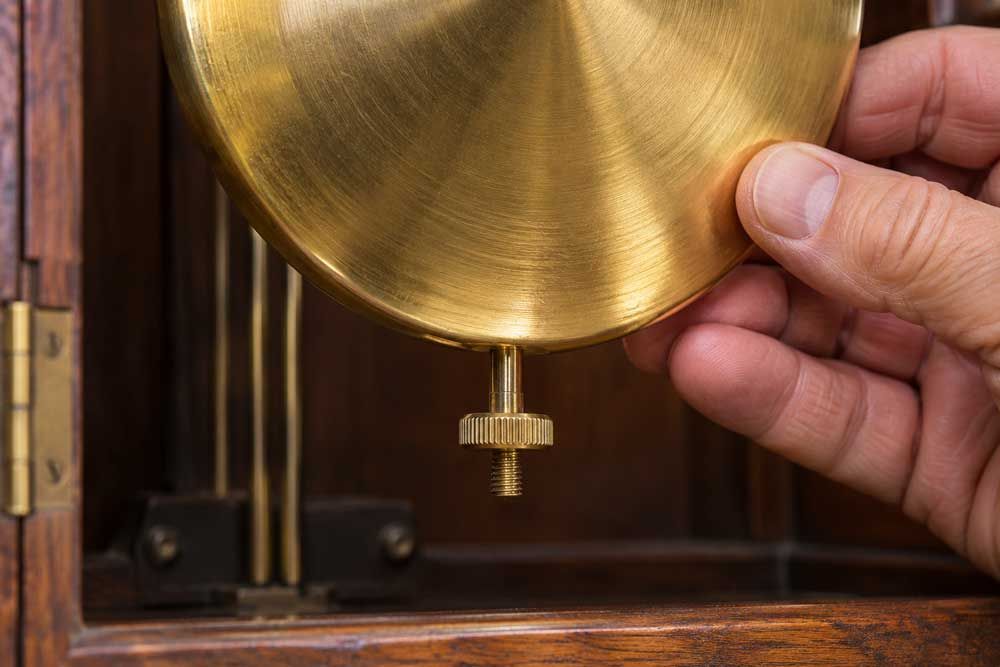
Mechanical heirloom clocks rely on three separate weights, each assigned to a specific function. One drives the time train, keeping the pendulum swinging and the hands advancing. A second powers the chime melody, lifting the hammers that play the quarter-hour sequence. The third drives the hour strike, releasing the count that tells you what hour has arrived. These weights are calibrated differently and are not interchangeable. Weight order matters. The heaviest weight typically belongs to the chime train, which demands the most power to operate its complex sequence of lifts and releases. When weights are hung on the wrong chains or pulleys, the chime train may receive insufficient power to complete its cycle, or, in some cases, more power than the mechanism expects, which can cause it to run erratically and skip the nighttime silencing phase entirely.
Most Howard Miller mechanical movements mark their weights on the bottom face of the brass casing: "Left," "Center," and "Right" as viewed from the front of the clock. If your weights have been mixed up, which happens frequently after a household move or when a well-meaning family member attempts to rewind the clock, the resolution is simple in principle. Carefully lower each weight to its lowest position, note the marking on its base, and rehang it on the corresponding chain or pulley. The brass casings are heavier than they appear, so take care to support each one fully as you lift and position it. A dropped weight can damage the chain, the pulley, or the cabinet floor, and the sudden release of tension can jolt the movement in ways that create new problems.
If your weights seem uneven or the chains have slipped off their sprockets, do not risk forcing them. Our team of experienced horologists at Chicago Clock Company can perform these delicate adjustments safely in your home. Contact us at 630 986 9210 to speak with a friendly neighbor who understands your timepiece.
Quartz Movement Night Shut-Off Troubleshooting
Quartz Howard Miller clocks rely on battery power to drive the automatic night shut-off. When the feature stops working, the cause is almost always low battery voltage, an incorrect initial time-setting sequence, or a light sensor that cannot do its job. Addressing these issues in order, starting with batteries, then the setup sequence, and finally the sensor, resolves the problem in the vast majority of cases.
Quartz movements are sometimes overlooked as the less serious cousins of mechanical heirlooms, but they deserve the same careful attention. The electronic silencing circuit that controls the night shut-off is calibrated to operate within a specific voltage range. Voltage is key. As batteries age, their output voltage drops gradually, often long before the timepiece stops running entirely. The movement may keep acceptable time while the silencing circuit receives insufficient voltage to activate reliably, producing the frustrating pattern of a night shut-off that works on some nights and fails on others. Fresh, high-quality alkaline batteries of the size specified in your movement's manual, typically C or D cells, are the first thing to replace, and rechargeable batteries should be avoided, as their slightly lower nominal voltage can cause exactly this kind of intermittent failure.
- Check the Batteries: Replace old batteries with fresh alkaline cells of the correct size. Even batteries that appear to have remaining charge may not supply the consistent voltage the silencing circuit requires.
- Verify the Switch: Locate the slide switch on the movement housing and confirm it is set to "Night Shut-Off" or "Sen" (Sensor) rather than "On" (chimes always active) or "Off" (chimes always silent). A switch inadvertently moved during winding or cleaning is a surprisingly common cause of apparent malfunction.
- Inspect the Light Sensor: If your Howard Miller quartz model uses a light sensor to detect daytime, ensure the sensor window is free of dust and that the timepiece is not positioned in a corner or alcove where ambient light levels remain low throughout the day. A sensor that cannot distinguish between day and night will default to one state or the other.
- Reset the Movement: Remove the batteries entirely, wait several minutes to allow the capacitors to discharge fully, then reinstall fresh batteries and follow your manual's exact sequence for setting the time. Many quartz movements require the time to be set to a specific hour, often 12:00, before the AM/PM logic initializes correctly.
Quartz movements do not carry the same weight of mechanical history as their gear-driven counterparts, but the clock cabinet surrounding them often does. If a quartz movement continues to malfunction after a full battery replacement and reset, the movement board itself may have developed a fault. At that point, the most practical path is professional evaluation: a horologist can determine whether the movement is serviceable or whether a replacement unit is the better choice for preserving the cabinet and its place in your home.
Frequently Asked Questions About Howard Miller Grandfather Clocks
How do I reset the chimes on my grandfather clock if they are out of sequence?
To reset the chimes, move the minute hand forward until the clock chimes, then manually move the hour hand to the hour corresponding to the number of chimes sounded. This aligns the physical hands with the internal strike count. Patience is required. Work clockwise only, allow each chime sequence to complete before advancing, and repeat as needed until the hands and strike count agree.
Are Howard Miller grandfather clocks worth anything today?
Yes, they often hold value depending on the age, condition, and model, though they are typically considered consumer-grade furniture rather than high-end antiques. Their true value, however, often lies in their role as a cherished family heirloom: an object that carries the rhythm of a household across generations, which no appraisal figure can fully capture.
Why did my grandfather clock suddenly stop working?
Common reasons include the weights needing to be wound, the pendulum being out of beat (not ticking evenly from side to side), debris or dust accumulation in the movement, or the cabinet sitting on a slightly unlevel floor. A simple leveling adjustment or a careful rewinding often restores the steady heartbeat. If the clock stops again within a day or two of being restarted, the movement likely needs professional cleaning.
My grandfather clock is chiming the wrong hour. How can I fix this?
Move the minute hand forward to the next hour and allow the clock to chime completely, counting the strikes carefully. Then carefully grasp the hour hand and reposition it to the number you just heard. Most Howard Miller hour hands are friction-fit and can be moved independently without engaging the chime train, making this a safe adjustment for most owners.
Is it okay to move my grandfather clock's hands backwards?
In most cases, moving the hands backward is not advisable on a mechanical movement. The chime lifting pins are designed to engage in one rotational direction, and reversing the minute hand risks bending those pins, jamming the strike release, or causing the count wheel to skip. Always advance the hands clockwise, pausing at each quarter-hour to let the chime finish.
Your heirloom clock has kept time through years of family life, preserving generations of stories through quiet mornings, late-night conversations, and the particular stillness of a house after everyone has gone to sleep. When its night shut-off fails, the disruption feels larger than a mechanical inconvenience, because the timepiece itself feels larger than a machine. Most of the causes described here are correctable with patience and the right approach: a careful AM/PM resynchronization, fresh batteries, correctly positioned weights, or a lever freed from years of dried lubricant. Some situations genuinely call for a trained hand, and there is no shame in recognizing that: these movements were built to last for generations precisely because they were designed to be serviced by people who understand them.
Since 1917, four generations of our family have served as Chicagoland's trusted guardians of heirloom timepieces. Whether you need a simple adjustment or a complete restoration, we treat your heirloom with the meticulous care it deserves. Visit us at our 431 Ogden Avenue location, or call our main line at 630 986 9210 to schedule an in-home preservation visit today. Let us help you keep the heartbeat of your home ticking perfectly.