Howard Miller Clock Weights: Which Goes Where (and Why It Matters)
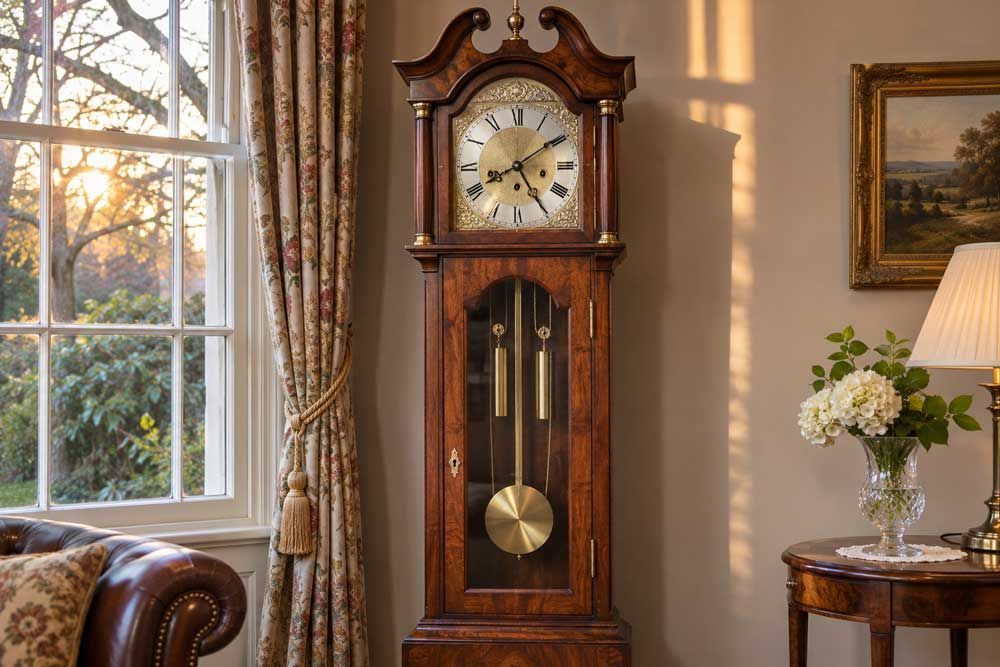
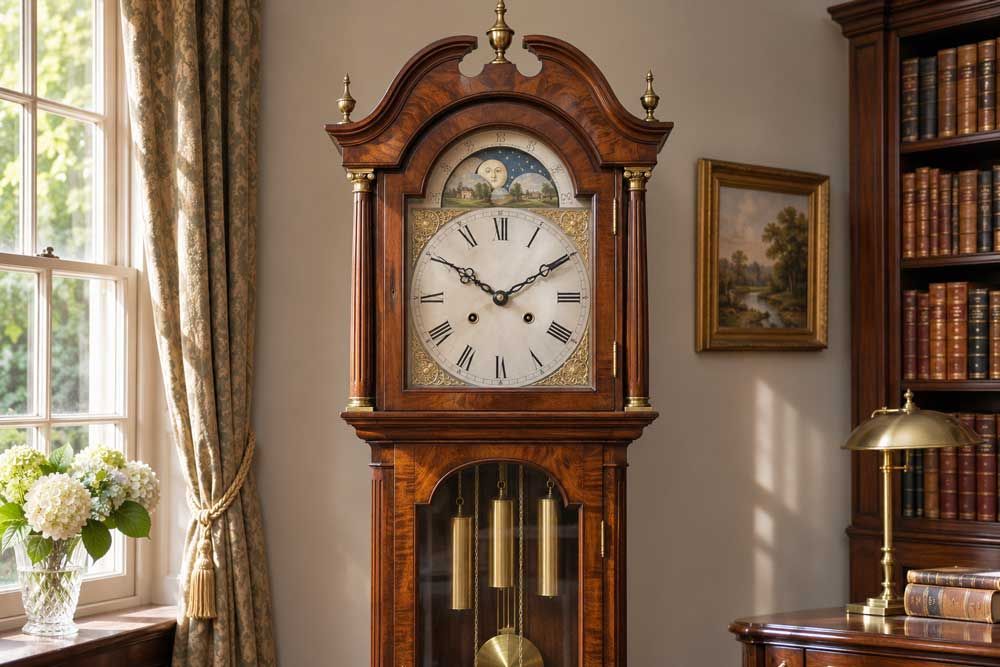
Standing in front of your Howard Miller grandfather clock with three brass-jacketed weights in hand, you might notice they look nearly identical: the same polished finish, the same cylindrical silhouette, the same satisfying heft. That resemblance is precisely what makes this moment feel precarious. Precision is everything. One wrong placement and the timepiece that has measured your family's mornings for decades could fall silent, not because it is broken, but because the gravity driving its heartbeat has been misdirected.
Your vigilance is well-placed. Each of these weights is a precisely calibrated instrument assigned to a specific mechanical function inside the movement. Getting their positions right is the single most consequential step in setting up or restarting a Howard Miller grandfather clock, and this guide walks you through exactly how to do it, from physical identification to safe handling to the environmental factors that affect performance long after the weights are hung. Since 1917, our family has helped collectors and neighbors preserve these mechanical heartbeats, and we understand the meticulous care they require.
Why Does Grandfather Clock Weight Placement Matter?
Grandfather clock weight placement matters because each weight powers a separate gear train inside the movement. Placing a weight on the wrong side disrupts the precise gravitational force required, causing the timepiece to run erratically, fail to chime, or stop entirely. Correct placement is the mechanical foundation your timepiece depends on.
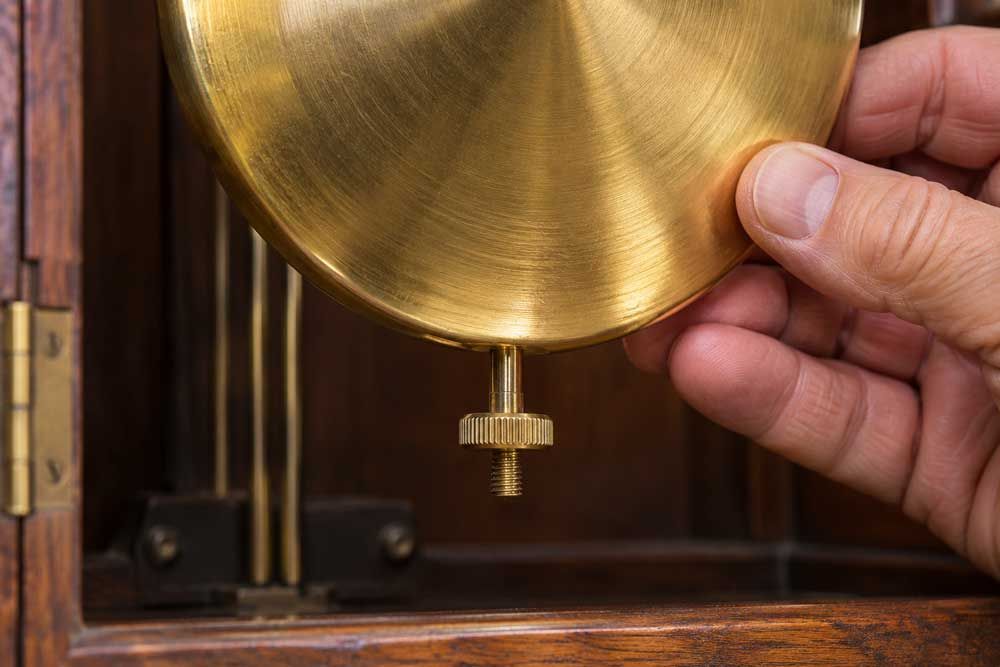
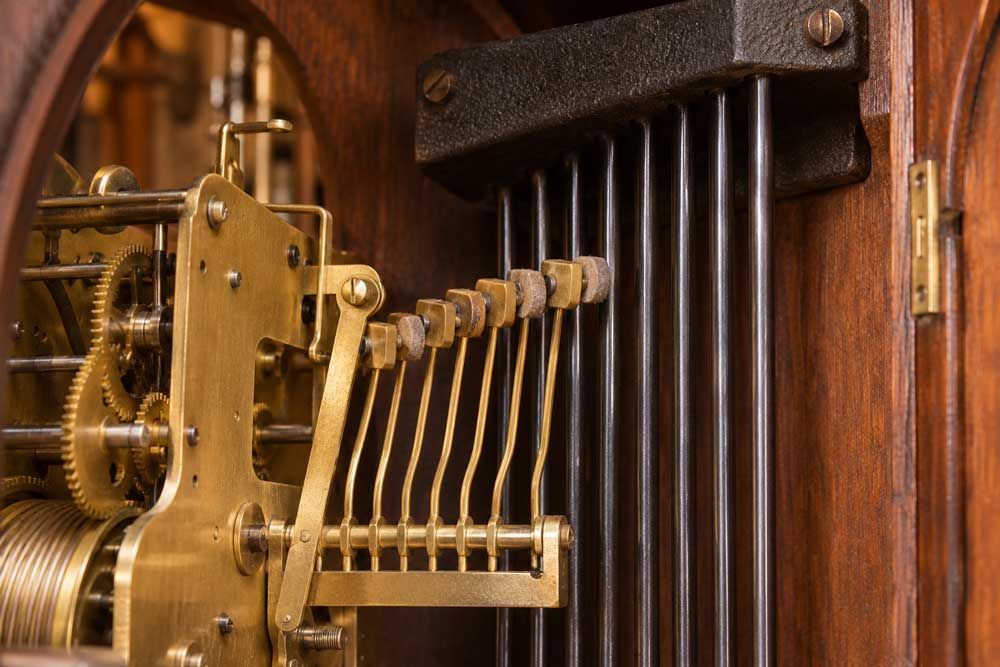
The three brass cylinders you are holding are called weight shells, the polished outer casings that house the actual weighted cores inside. While they look visually identical from the outside, the inner cores often differ in mass because each gear train demands a different amount of gravitational force to function correctly. The timekeeping train, which regulates the pendulum and moves the hands, requires the least force. The strike train, which counts out the hours with its resonant tone, needs a moderate amount. The chime train, which plays the full musical sequence, whether Westminster, Whittington, or St. Michael, demands the most because it must drive a complex rotating drum and multiple hammers in a precise, timed sequence.
These distinctions are what gravity-driven mechanics make non-negotiable. Gravity never compromises. The movement does not have a motor to compensate for an undersupplied train or a governor to throttle an oversupplied one. It runs on exactly what you give it, which means the calibration you establish when you hang those weight shells is the calibration the movement will work with, for better or worse, until someone changes it.
Placing a weight that is too heavy on the timekeeping side accelerates wear on the delicate pivots and gear teeth far beyond what the manufacturer designed for. A weight too light on the chime side will stall the train mid-sequence, leaving the melody incomplete or silencing it entirely. Over time, either scenario compounds: gears running under the wrong load accumulate wear faster, oils break down unevenly, and what began as a placement error quietly becomes a mechanical problem that requires intervention. Regular professional clock repair services , including cleaning, oiling, and movement inspection, keep the gear trains running within their intended tolerances and give a trained eye the opportunity to catch early wear before it becomes a failure.
How To Identify The Left, Center, And Right Howard Miller Weights
To identify which Howard Miller weight goes where, compare their physical weights. The heaviest belongs on the right for the chime, the medium weight on the left for the strike, and the lightest in the center for timekeeping. You can also inspect the bottom of each shell for factory stamps marked L, C, or R.
The identification process is simple, but it rewards patience and a careful setup. Take your time. Lay a soft, folded towel on a stable surface before you begin; the lacquered brass finish on weight shells scratches more easily than it looks, and a single careless set-down can leave a mark that dulls the polish permanently. With the towel in place, carefully remove each weight from its hook and set them side by side. Lift each one deliberately, shifting it from hand to hand to get a genuine sense of its weight distribution relative to the others. The difference between the lightest and heaviest is often more pronounced than you would expect, though the gap between the lightest and the middle weight can be subtle enough that you will want to compare them directly rather than relying on memory. If you find the factory stamps on the bottom of the shells, use them: they remove all ambiguity and are the most reliable guide available.
Facing the dial from the front, the standard weight assignment for a three-weight Howard Miller movement is:
- Left Weight (Strike): Powers the hourly strike mechanism, which is the gear train that counts out the hours with a resonant, measured tone. This weight falls in the middle range of the three in terms of physical heaviness.
- Center Weight (Time): Powers the timekeeping mechanism, regulating the pendulum's arc and driving the hands forward. It is consistently the lightest of the three, because the time train requires less gravitational force than either the strike or chime trains.
- Right Weight (Chime): Powers the musical chime melody, such as Westminster, Whittington, or St. Michael, depending on your model. This is the heaviest weight, because the chime train must drive a rotating drum and a set of individual hammers in a precise, timed sequence.
- Inspect the bottom of each weight shell for faint stamps or adhesive stickers reading "L," "C," or "R." Many Howard Miller models include these markings from the factory, and finding them removes any ambiguity entirely.
If handling three heavy, polished brass weight shells feels like more risk than you want to take with a treasured heirloom, or if your timepiece remains silent even after you have verified the weight positions, you do not have to work through it alone. The master horologists at Chicago Clock Company offer in-home grandfather clock repair , traveling directly to your home to safely diagnose, level, and calibrate your Howard Miller timepiece. Call us at 630 986 9210 to schedule a visit.
Safe Handling: How To Hang And Wind Your Timepiece Weights
To safely hang and wind Howard Miller timepiece weights, ensure each shell is securely hung on its correct hook or pulley before winding. Apply controlled pressure throughout the process, whether pulling chains or turning a crank key, and stop immediately when you feel resistance. Never force the mechanism.
Howard Miller grandfather clocks use one of two drive systems: chain-driven movements, where you pull the hanging chains downward to raise the weights, or cable-driven movements, where a crank key inserted into the dial face winds the cables around their respective drums. The mechanical motion differs between the two, but the underlying principle is the same: you are storing gravitational potential energy in the raised weights, which the movement then releases in a controlled, metered descent over the course of the week. The manufacturer-approved winding direction for your specific movement is worth confirming in your owner's manual before you begin, because attempting to wind against a stopped movement in the wrong direction places unnecessary stress on the cables and their anchor points. Wind slowly, feeling for resistance as you go. If the key or chain resists before the weight has reached its upper travel limit, stop and investigate rather than applying more force; a chain that has jumped its sprocket or a cable that has slipped its drum will resist winding, and forcing past that resistance is how minor issues become expensive repairs.
One handling mistake that appears well-intentioned but causes real damage is lifting the weights by hand while winding, as if helping the timepiece along. When you support a weight from below, you remove the tension from the cable or chain above it. That slack allows the cable to jump its pulley or the chain to skip its sprocket, and when you release the weight, the line wraps around a gear arbor or piles up inside the movement in a tangle that requires disassembling the movement to clear. The weights must hang freely at all times, descending under their own gravity at the pace the escapement allows. Interfering with that descent, even briefly, disrupts the tension the entire drive system depends on. Let gravity do the work.
A practical safety checklist for hanging and winding:
- Wear Cotton Gloves: Handle brass weight shells with clean cotton gloves or a soft cloth. Skin oils penetrate the lacquer finish over time, leaving permanent tarnish marks that no amount of polishing fully reverses.
- Verify Hook Engagement: Before releasing each weight, confirm that the loop at the top of the shell is fully seated in the hook of its pulley or chain link. A partially engaged hook can slip under load, dropping the weight and potentially damaging the movement or the cabinet floor.
- Maintain Steady Tension: Keep steady downward tension on the weight throughout winding to prevent the cable or chain from going slack and slipping off its drum or sprocket.
- Stop Before Overwinding: Cease winding when the weight is approximately two inches below the wooden movement board at the top of the case. Winding past this point risks damaging the cable anchor or the drum itself, damage that is rarely visible until the timepiece stops unexpectedly.
- Check that all three weights hang plumb and clear of each other, the pendulum rod, and the interior walls of the wooden case. Even minor contact creates friction that can slow or stop the movement without any other obvious cause.

Troubleshooting Common Weight-Related Issues
When grandfather timepiece weights fail to drop or cause the timepiece to stop, the most common culprits are swapped weights, tangled cables or chains, and a timepiece cabinet that is out of level. Checking these three conditions in order- weight positions first, then cable and chain integrity, then cabinet level- resolves the majority of weight-related stoppages without requiring professional intervention.
A timepiece cabinet that is even slightly tilted can introduce problems that appear entirely unrelated to leveling. When the case leans, the pendulum's arc shifts away from its designed center path, and the heavy weights can drift toward the pendulum rod or the cabinet walls. That contact, sometimes nothing more than a whisper of friction at the arc's outermost point, is enough to interrupt the escapement and stop the timepiece. A spirit level placed on the sill of the timepiece's waist door reveals any tilt from side to side; checking front-to-back matters equally, because a forward lean changes how the pendulum swings relative to the escapement pallet. Most Howard Miller cabinets have adjustable leveling feet at the base, and small corrections there often resolve stoppages that seemed mysterious at first glance.
Tangled cables occupy a different category of problem, and they deserve considerably more caution. Never force a cable. A cable that has wrapped around a gear arbor or piled up inside the movement is not something to pull free by hand. The cables run under significant tension when the weights are hung, and yanking on a tangled line can bend the arbor, strip the cable anchor, or pull the entire weight drum out of alignment. If you can see that a cable has left its pulley, lower the affected weight as far as it will go before attempting anything else. Whether to proceed further yourself or call for professional help depends on how accessible the tangle is, but when in doubt, the cost of a service call is far less than the cost of a damaged movement.
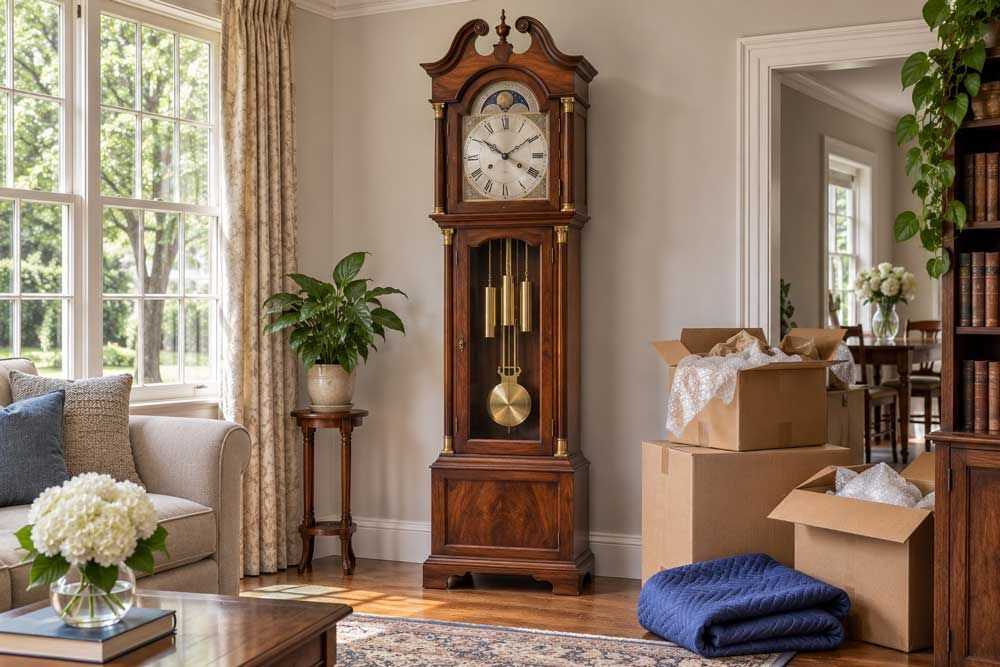
Forcing a jammed chain, attempting to free a tangled cable without proper preparation, or moving a grandfather timepiece without securing the weights and pendulum can cause damage to the escapement or the wooden cabinet that far exceeds the cost of a service call. Chicago Clock Company offers complete clock installation and setup services: whether you are relocating to a new home in Chicagoland or simply rearranging your living room, our family will safely dismantle, pack, transport, level, and calibrate your Howard Miller timepiece, ensuring the weights and pendulum are perfectly aligned when it is time to start the timepiece again.
Environmental Impacts On Your Timepiece's Performance
Local environmental conditions affect grandfather timepiece movements more than most owners anticipate. For timepieces in the Chicagoland area, these three factors demand continuous attention:
- Seasonal Humidity Shifts: Chicago's humid summers and dry winters cause the wooden cases of grandfather clocks to expand and contract measurably across the year. That dimensional change can shift the cabinet out of level between service visits, causing weights to drift toward the pendulum rod or the case walls, which is a slow, gradual process that may not become apparent until the timepiece stops.
- Dust and Dirt Accumulation: Airborne dust mixes with the clock's lubricating oils over time, forming a gritty paste that increases friction on the gear teeth and pivots. When the gears bind, the weights must work harder to drive the trains, which accelerates mechanical wear and shortens the interval between necessary cleanings. The problem compounds quietly: the timepiece may keep running for months before the accumulated friction becomes enough to stall a train.
- Temperature Fluctuations: Rapid temperature changes near drafty windows, heating vents, or fireplaces alter the viscosity of the oil inside the movement. Thickened oil in winter or thinned oil in summer changes how freely the gear trains run, which in turn affects how evenly the weights descend and how accurately the escapement meters their energy.
Mitigating these effects starts with careful placement. A Howard Miller grandfather timepiece performs best away from direct sunlight, exterior walls with significant thermal variation, heating and cooling vents, and fireplaces- locations that seem natural for a tall, handsome piece of furniture but expose the movement to the very conditions it handles poorly. Beyond placement, the most reliable protection is a consistent service schedule. Routine care is vital. Professional cleaning and oiling every three to five years remove accumulated grit, refresh the lubricants, and give a trained eye the opportunity to catch early signs of wear before they become failures. A timepiece that receives this kind of attention holds its calibration far more reliably between visits, and the quiet heartbeat and soft chime that define its presence in a room remain consistent regardless of what the Midwestern weather is doing outside.
Frequently Asked Questions About Howard Miller Timepieces
What is the average weight of a grandfather timepiece?
The average grandfather timepiece typically weighs between 100 and 200 pounds, though this can vary significantly based on the materials used in the cabinet and the weight of the internal movement and pendulums.
Where can I find a free timepiece parts catalog?
Several major timepiece supply companies, such as Merritt's Antiques, Timesavers, and Perrin, offer digital or print catalogs that can be requested through their official websites.
Can you use WD-40 on timepiece movements?
No, you must never use WD-40 on timepiece movements because it is a solvent, not a lubricant; it will eventually gum up, attract dust, and cause severe damage to the delicate gears. Purpose-formulated timepiece oils are the only appropriate lubricants for these mechanisms, as using anything else risks compounding wear rather than preventing it.
Are Howard Miller grandfather timepieces worth anything?
Yes, they hold value for collectors and enthusiasts, though their resale price depends heavily on the model's age, condition, rarity, and whether the movement is in good working order.
What are the common problems with Howard Miller grandfather timepieces?
Common issues include the timepiece stopping due to the need for professional cleaning and oiling, weight shells becoming stuck, chime synchronization problems, and pendulum suspension springs breaking.
A grandfather timepiece is not a passive object in a room. It marks the hours with a voice, and that voice carries the accumulated weight of every morning your family has woken to its chime, every anniversary it has counted, every quiet evening it has kept company. Caring for the weights that power it, understanding which one belongs where and why, is one of the most direct ways to honor what the timepiece represents and extend its life for the people who come after you.
Understanding the mechanics and executing the maintenance are two different things, though, and there is no obligation to carry that responsibility alone. Chicago Clock Company's master horologists, Jason Matthiesen, Louie Matthiesen, and Conrad Utecht, have spent their careers preserving timepieces exactly like yours, bringing the same patient attention to a weight placement question as to a full movement restoration. You will find us at our Palatine showroom at 1615 North Rand Road (847-359-5805) and our Orland Park location at 14486 LaGrange Road (708-349-2565). Both showrooms are open Monday through Friday from 10 am to 6 pm and Saturday from 10 am to 5 pm. We are here to help. Whether your clock needs a routine evaluation or a careful, unhurried restoration, we treat every piece as the heirloom it is, because that is precisely what it is.
To schedule an in-home service appointment or bring your clock in for an evaluation, call us at 630 986 9210. Our horologists, Jason Matthiesen, Louie Matthiesen, and Conrad Utecht, are ready to provide the careful, meticulous attention your Howard Miller timepiece deserves. Visit our Palatine showroom at 1615 North Rand Road (Monday through Friday, 10 am to 6 pm; Saturday, 10 am to 5 pm; 847-359-5805) or our Orland Park location at 14486 LaGrange Road (same hours; 708-349-2565). Whether you need a routine cleaning, a complex movement restoration, or professional assistance setting up your clock after a move, we are here to help keep your family's heartbeat running for generations to come.