Howard Miller Grandfather Clock Chimes at the Wrong Time: How to Fix It
There is something quietly unsettling about a grandfather clock that chimes at the wrong hour. For most owners, these clocks represent the audible heartbeat of a home, often serving as the last tangible connection to someone who is no longer here. When that rhythm breaks, the instinct is to fix it immediately, and the fear that follows is just as immediate: what if I make it worse?
That anxiety is completely reasonable. A Howard Miller grandfather clock is a precision instrument, and its internal gearing deserves the same careful respect you would give a fine mechanical watch. The good news is that chime desynchronization, while alarming, is one of the most frequent and rectifiable issues these clocks develop over time. These steps cover the diagnostic and repair process for both mechanical (weight-driven) and quartz (battery-operated) Howard Miller movements, walking you through safe, deliberate steps to bring the hands and chimes back into alignment without risking damage to the mechanism. Chicago Clock Company has served as the custodian of heirloom timepieces since 1917, and the guidance here reflects that same measured, generational approach to clock care.
Understanding Why Your Howard Miller Grandfather Clock Chimes at the Wrong Time
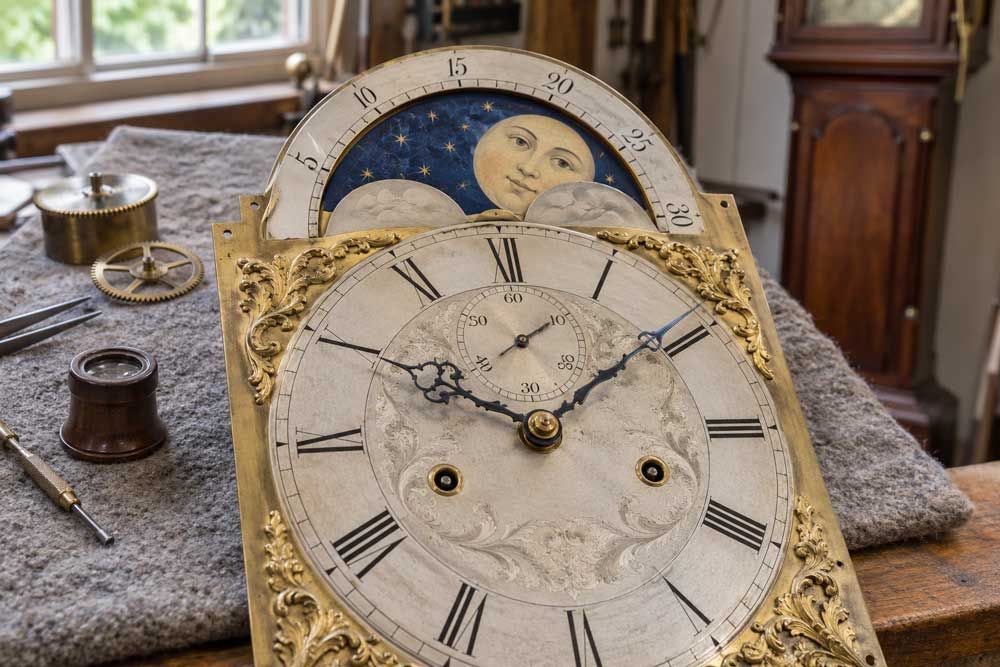
A Howard Miller grandfather clock chiming at the wrong time is typically caused by a desynchronization between the hands and the internal chime mechanism. This occurs when the hands are moved manually without allowing the chimes to complete their full cycle, or when the minute hand gradually slips on its arbor, which is the central shaft on which the hands are mounted, disrupting the mechanical alignment between the dial and the strike train.
To understand why this happens, it helps to think about how the two systems relate to each other. The hands on the dial and the internal strike-regulating mechanism must work in continuous, coordinated unison. The minute hand, as it sweeps around the dial, physically triggers the chime sequence at each quarter-hour interval. When that hand is even slightly out of position on its arbor, whether from a previous manual adjustment, a temperature-related shift, or simple wear over time, the trigger points drift. The clock's internal mechanism still fires at the positions it expects, but those positions no longer correspond to where the hands actually point.
Mechanical movements (weight-driven, with a swinging pendulum) and quartz movements (battery-operated, with an electronic chime speaker) behave very differently when this misalignment occurs, and they require entirely different corrective approaches. On a mechanical movement, the fix almost always involves physically repositioning the hands relative to the strike train. On a quartz movement, the issue is more often electronic, such as a depleted battery causing the microprocessor to lose its strike count, and the remedy is correspondingly simpler.
What both types share is a low tolerance for impatience. A grandfather clock cannot be forced back into alignment. The delicate gears inside a mechanical Howard Miller movement are hand-assembled and require careful oiling to maintain their smooth, whispering rhythm; their precise pivot points and bushings can be permanently damaged by a single moment of excessive pressure. Rushed adjustments that feel productive in the moment can translate into expensive restoration work later. The goal here is to move deliberately, pause when the clock asks you to, and resist the urge to rush past a chime cycle because it feels like wasted time.
How to Synchronize the Hour Strike with the Clock Hands
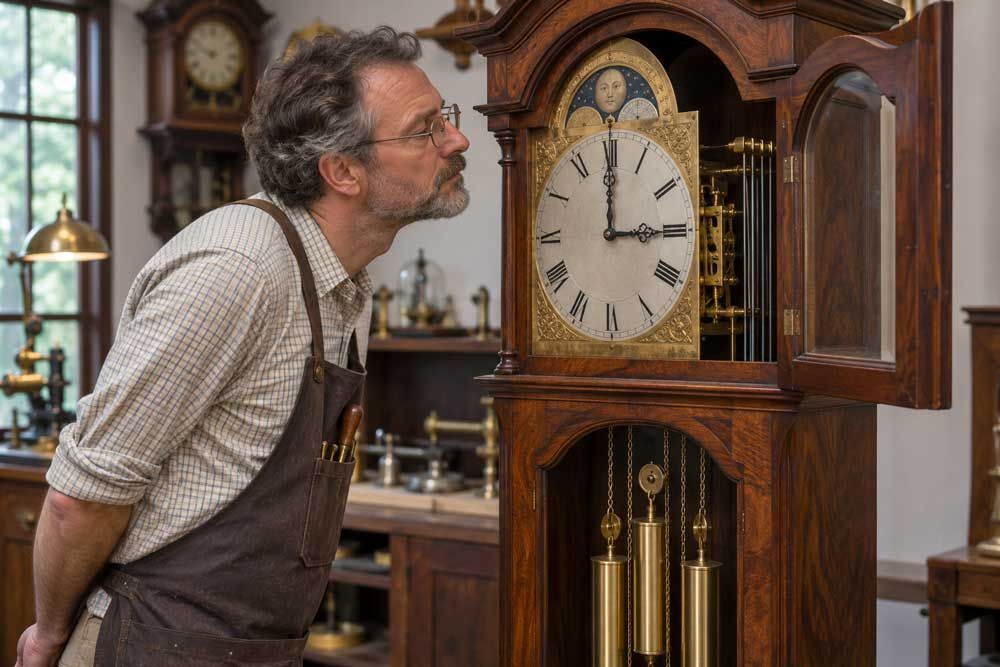
To synchronize the hour strike, advance the minute hand to the next hour and count the number of strikes. Then, carefully grasp the short hour hand near the center shaft and slide it manually to point directly to the hour that was just struck. The hour hand on most Howard Miller mechanical clocks is designed to slip on its shaft specifically to allow this adjustment without engaging the gear train.
Understanding the Hour Hand Friction Fit
On most Howard Miller mechanical grandfather clocks, the hour hand is held in place by a friction fit: it sits on a tapered sleeve and grips through tension rather than being locked by a nut or pin. This design is intentional. Because the hour hand is mechanically independent of the chime-triggering sequence (which is governed entirely by the minute hand's position), it can be repositioned without touching or disturbing the internal strike-regulating mechanism. Moving the hour hand does not reset the gear train; it simply changes where the hand points on the dial.
This distinction matters enormously for the repair process. Many owners assume that adjusting the hour hand will somehow interfere with the internal mechanism, so they avoid it. In practice, carefully rotating the hour hand to match the struck hour is the safest and most direct way to restore synchronization when the hands and chimes have drifted apart. The key qualifier is careful movement: the friction fit is designed exclusively for light, deliberate repositioning.
Step-by-Step Hour Hand Synchronization
Before beginning, make sure the pendulum is swinging, and the clock is in its normal operating position. Do not attempt this adjustment while the clock is mid-chime.
- Rotate the minute hand slowly clockwise to the next hour position and allow the clock to complete its full chime and strike sequence without interruption.
- Count the number of strikes carefully. If the clock strikes five times, the internal mechanism currently registers the time as 5 o'clock.
- Grasp the short hour hand carefully near the center shaft, not at the tip, and rotate it to point directly at the number that matches the strike count. Do not touch or reposition the minute hand during this step.
- Once the hour hand is aligned, use the minute hand to advance the clock to the correct local time. Move it slowly and pause at the 15-, 30-, and 45-minute marks to allow each quarter-hour chime to play out completely before continuing.
If the clock is significantly off, for example, striking 3 when it should be striking 9, you may need to advance the minute hand through several full hours to reach the correct time. That process takes patience, but it is the only safe way to do it. Skipping chime cycles by moving the hand too quickly risks jamming the strike train.
If the hour hand feels tight, resistant, or refuses to move with light pressure, stop. Do not apply additional force. A seized friction fit or a bent arbor requires professional attention, and attempting to force it can cause damage that goes well beyond a simple alignment issue. Contact Chicago Clock Company at 630 986 9210 before proceeding; our team can walk you through the next steps or arrange an assessment.
Fixing Minute Hand Alignment and Chime Timing
When a grandfather clock chimes a few minutes before or after the hour, the minute hand has slipped on its arbor. To correct this, you must loosen the hand nut, remove the minute hand, and rotate the hand bushing slightly to realign the chime trigger point with the correct position on the dial before reinstalling the hand.
The Minute Hand Bushing Mechanism
The minute hand on a Howard Miller mechanical clock is mounted on a small brass hand nut and bushing assembly that sits on the hand arbor. The bushing is the component that actually contacts the arbor and determines where the hand sits in relation to the internal trigger points. Over time, particularly after daylight saving time adjustments or any manual time-setting, the bushing can shift slightly, causing the chime to fire two or three minutes before the hand reaches the 12, 3, 6, or 9 o'clock positions.
Temperature fluctuations inside the clock case can also contribute to this slippage. Wood cases expand and contract seasonally, and even small movements in the case can translate into subtle shifts in how components seat against each other. It is not always a single dramatic event that causes the misalignment; sometimes it accumulates gradually over months until the offset becomes noticeable.
The critical warning here: the minute hand must never be forced backward past the chime release points. Doing so can cause severe damage to the strike cams, which are the components inside the movement that govern when and how many times the clock strikes. Even a single forceful backward rotation can strip or bend these parts, converting a simple alignment issue into a full mechanical restoration. When loosening and repositioning the hand nut, use appropriately sized small hand tools and apply only axial pressure (straight in and out along the shaft). Any lateral pressure on the arbor risks bending it, and a bent arbor is not a field repair.
Step-by-Step Minute Hand Realignment
Because the manufacturer-approved method for loosening the minute hand nut without applying lateral stress to the arbor varies by specific Howard Miller model, exercise extreme caution throughout this process and consult your clock's original manual if available before beginning.
- Stop the pendulum and allow the clock to come to a complete rest.
- Locate the small nut securing the minute hand at the center of the dial. Using small pliers or a specialized clock hand wrench, carefully loosen and remove the nut while holding the minute hand steady with your other hand to prevent the arbor from rotating.
- Pull the minute hand straight off the shaft, taking care not to angle it, and locate the small brass bushing on the back of the hand near the center hole.
- Hold the bushing firmly and rotate the minute hand slightly in the direction needed to correct the timing error. If the clock was chiming three minutes early, rotate the hand three minutes forward relative to the bushing; if it was chiming late, rotate it backward by the same margin.
- Reinstall the hand onto the shaft, pressing it straight on without lateral wobble. Tighten the nut securely, but stop before the point where additional torque would stress the arbor. Restart the pendulum and observe the clock through at least two full chime cycles to confirm the correction.
Troubleshooting Quartz (Battery-Operated) Howard Miller Movements
Quartz Howard Miller grandfather clocks regulate their chimes electronically rather than mechanically. If the chimes are firing at the wrong time, the most common cause is low batteries causing the microprocessor to lose its strike count, or a desynchronized electronic counter. Installing fresh alkaline batteries and using the chime reset function on the movement typically resolves the issue.
Troubleshooting Electronic Chimes
Quartz movements do not use weights or mainsprings to power the chime sequence. Instead, an electronic pulse from the battery-driven motor triggers a speaker or chime rod mechanism at programmed intervals. When battery voltage drops below the threshold the microprocessor needs to maintain its internal count, the strike sequence can drift, sometimes gradually and sometimes in sudden jumps, producing chimes that bear no consistent relationship to the position of the hands.
Because there is no single, universally reliable indicator that distinguishes a low-battery state from a more significant electronic fault, the practical starting point is always a full battery replacement. Use fresh, high-quality alkaline batteries: do not use rechargeable cells, which deliver slightly lower voltage and can cause erratic behavior in clock microprocessors. If the chime sounds distorted, muffled, or the hands are moving sluggishly before the replacement, those are reasonable signs that battery depletion is the primary culprit. After installing new batteries, locate the chime selector or reset function on your specific movement (the position varies by model; consult your Howard Miller manual) and cycle it to allow the electronic counter to resynchronize.
It is worth noting that quartz movements, while far simpler to troubleshoot than their mechanical counterparts, are not immune to component failure. A microprocessor that continues to miscount strikes after a fresh battery installation, or a chime speaker that produces distorted tones regardless of battery condition, may indicate a failed circuit board or speaker unit. Those repairs go beyond battery swaps and hand adjustments.
If the electronic chimes remain out of sync after replacing the batteries, or if you are uncertain about opening the movement panel, the most prudent step is to bring in a professional. Book an in-home grandfather clock repair service with Chicago Clock Company's factory-authorized caretakers, and we will diagnose the issue at your home without requiring you to transport the clock.
Safe Time-Setting and Maintenance Practices to Prevent Chime Issues
To prevent future chime desynchronization, always allow the clock to complete its full chime cycle at each quarter-hour mark when advancing the time manually. Never force the hands backward past the chime release points unless your specific Howard Miller manual explicitly states that the movement permits reverse-hand movement.
Safe Time-Setting Habits
Manual time adjustments are the single most common source of chime misalignment in well-maintained grandfather clocks. The mechanism is designed to be advanced forward: the quarter-hour chime triggers are positioned along the forward arc of the minute hand's travel, and bypassing them by moving too quickly, or reversing direction past them, disrupts the sequence the internal mechanism expects.
- Always advance the hands slowly, pausing at the 15-, 30-, 45-, and 60-minute positions to allow each chime sequence to play out completely before continuing.
- Never wind the clock while the chimes are actively playing or striking, as simultaneous tension on the gear train can accelerate wear on the gear teeth.
- Regarding direction: the safest default is to advance the hands clockwise only. Whether your specific Howard Miller movement permits counter-clockwise hand movement depends on the model; consult your original manual before attempting any reverse adjustment, and when in doubt, move only forward.
Daylight saving time changes are a particularly high-risk moment for these clocks. Moving the hands forward one hour is straightforward; moving them back one hour requires either reversing the hands (which many movements do not support) or advancing them eleven hours forward instead. Eleven hours of slow, pause-at-every-quarter-hour advancement takes time, but it is the method that protects the mechanism.
Professional Custodianship and Maintenance
Beyond the adjustments an owner can make at home, grandfather clocks require periodic professional cleaning and oiling, generally every three to five years, to protect the delicate gears. Over time, clock oil degrades, and dried or oxidized lubricant creates friction at the very points where the movement needs to run freely. When the gentle heartbeat of your timepiece has grown weary, it deserves a careful restoration to bring it back to life, rather than running on old oil that accelerates wear.
Professional custodianship also catches problems before they become expensive. A trained horologist examining a movement can identify a worn bushing or a pivot that is beginning to show stress long before those issues cause a visible symptom. For a clock that carries genuine family history, this preventive care ensures the timepiece will survive to serve another generation.
Many of the questions owners bring to us at Chicago Clock Company, including queries about chimes that drift seasonally, hands that feel slightly stiffer than they used to, or a pendulum that needs more frequent regulation, trace back to a movement that simply needs a thorough cleaning and fresh lubrication. The clock is telling you something; the question is whether you catch it early.
Chime synchronization issues, hand alignment, and movement maintenance all connect to a set of questions that come up repeatedly among Howard Miller owners. The following addresses the most common of them directly.
Frequently Asked Questions About Grandfather Clock Chimes
How do you reset the chimes on a grandfather clock?
To reset the chimes, synchronize the hands with the strike train by advancing the minute hand to the 12 o'clock position, allowing the clock to strike, and counting the blows. Then manually move the hour hand to match the number struck. Alternatively, move the chime selector lever to the "OFF" position, set the clock to the correct time, and return the lever to "ON" to allow the mechanism to resynchronize from a known position.
Are Howard Miller grandfather clocks worth anything?
Yes, Howard Miller grandfather clocks hold meaningful value, particularly models with mechanical, weight-driven movements and high-quality hardwood casings. Secondary market prices vary considerably based on age, model, condition, and movement type, and they often sell for a fraction of their original retail price. Their deeper value, however, tends to be irreplaceable: these clocks frequently carry decades of family history that no resale figure can accurately represent.
Why is my clock displaying the wrong time?
In quartz models, a low or depleted battery is the most common cause. In mechanical models, the weights may need winding, or the hands may have slipped on their arbors. A clock that is not sitting perfectly level can also lose or gain time, as the pendulum's arc is sensitive to the case's orientation. Dried internal lubricant is another factor worth considering if the clock has not been professionally serviced in several years.
My Westminster chime is out of sync. How can I fix it?
Advance the minute hand slowly to the next quarter-hour position and allow the chime to play completely, then continue to the next quarter-hour and repeat. Many modern Howard Miller movements with Westminster chimes will self-correct within one to two hours of this process, as the internal mechanism recalibrates against the hand positions. If the chime remains out of sync after cycling through several hours, a manual hand alignment or professional inspection is the appropriate next step.
My Howard Miller grandfather clock is striking the wrong hour. How can I fix this?
Wait for the clock to finish its current strike sequence, then count the strikes carefully. Grasp the short hour hand carefully near the center shaft and slide it to point directly at the number that was just struck. This repositions the hour hand without disturbing the internal strike-regulating mechanism. Once aligned, advance the minute hand slowly to the correct current time, pausing at each quarter-hour to let the chimes complete.
A grandfather clock that has been in a family for decades carries something that cannot be replicated: not the movement, not the case, and not the particular quality of its chime at seven in the morning. Restoring its rhythm is an act of preservation, and it deserves the same unhurried attention the clock itself was built to embody. Chicago Clock Company has been caring for these timepieces since 1917, across four generations of our own family, and we understand what it means to be trusted with something irreplaceable. Whether the fix is a simple hand alignment you can manage at home or a movement that needs professional attention, the goal is always the same: keeping the clock running for whoever inherits it next.
Owners in the Chicagoland area are welcome to bring their clocks to our main location at 431 Ogden Avenue, or arrange for one of our master horologists to come to them. Our Orland Park location is at 14486 LaGrange Road (708-349-2565), open Monday through Friday from 10 am to 6 pm, and Saturday from 10 am to 5 pm. Our Palatine location is at 1615 North Rand Road (847-359-5805), with the same hours. Jason Matthiesen, Louie Matthiesen, and Conrad Utecht are each dedicated to the careful, long-term preservation of your timepiece. To schedule a visit from our team, explore our grandfather clock repair services and book directly online.