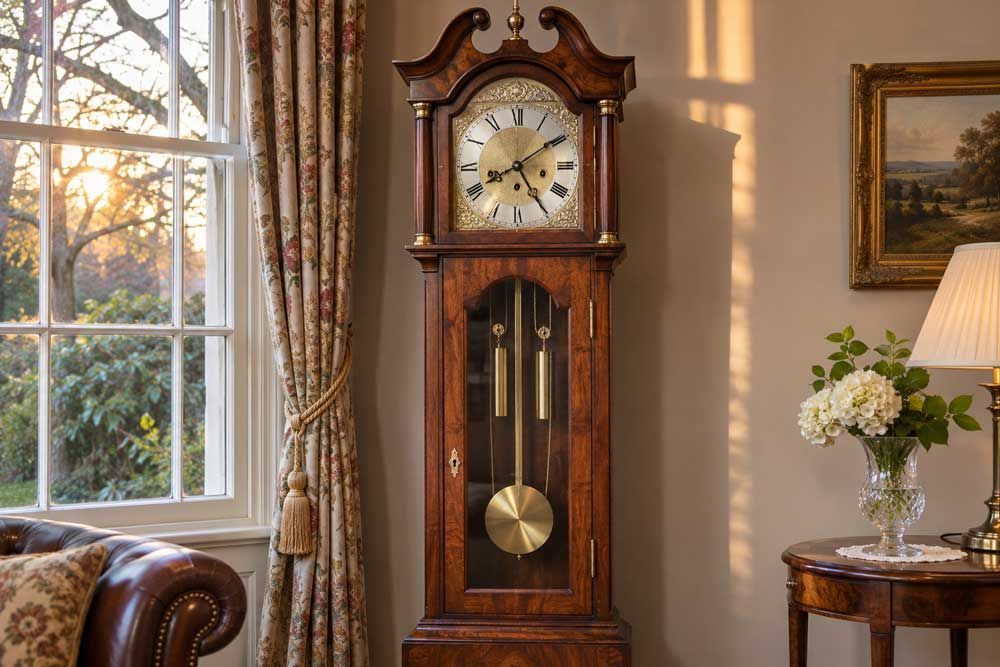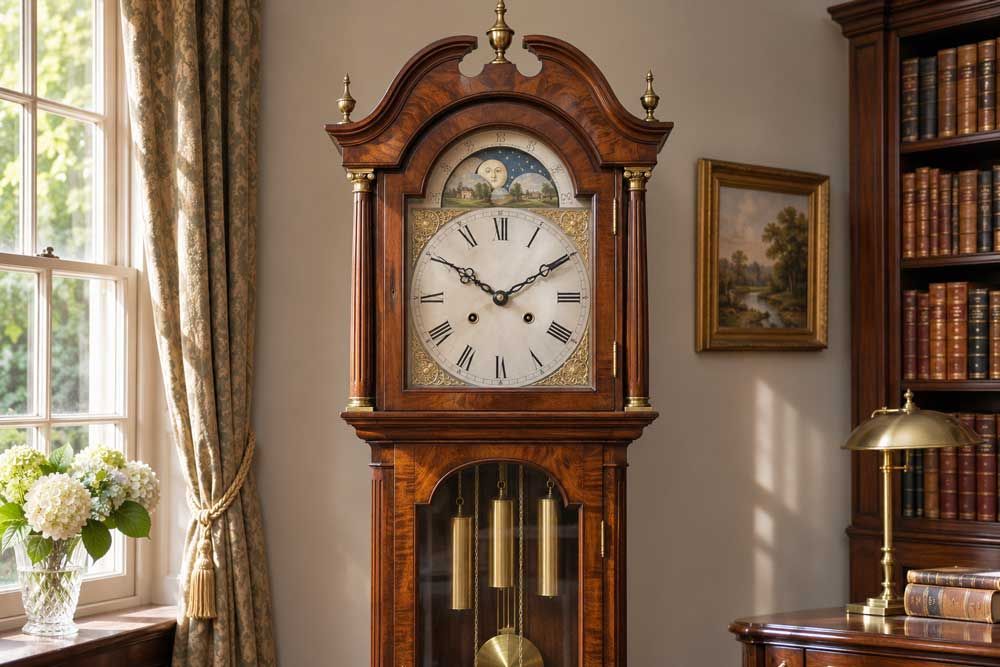
Howard Miller Grandfather Clock Chimes at the Wrong Time: How to Fix It
A grandfather clock that gains five minutes by Friday morning is not merely an inconvenience: it is a signal that something in a precisely calibrated mechanical system has shifted. For many families, that signal carries real weight. Time is personal. These heirloom timepieces have marked birthdays, anniversaries, and quiet Sunday mornings for decades, sometimes across multiple generations. The thought of handling the intricate internal assembly without proper guidance is genuinely unsettling.
Most timekeeping drift in a Howard Miller grandfather clock traces back to a single, accessible component: the pendulum. Adjusting it does not require a workshop full of specialized equipment. What it requires is patience, a careful hand, and a clear understanding of what you are changing when you turn that small nut beneath the pendulum bob.
Our family at Chicago Clock Company has served as custodians of family memories since 1917, and the guidance here reflects four generations of hands-on experience with Howard Miller timepieces.
Understanding the Mechanics of Pendulum Regulation
A Howard Miller grandfather clock regulates time through the rhythmic swing of its pendulum, where the duration of each swing depends on its length. Turning the rating nut below the pendulum bob upward shortens the assembly to speed up the clock, while turning it downward lengthens the rod to slow the timekeeping, requiring a delicate touch to avoid disturbing the suspension spring at the top.
Think of the pendulum as the clock's conductor. It sets the pace. Every tick and tock is one complete beat: the pendulum swings left, then right, and the escapement releases exactly one tooth of the gear train with each pass. The pendulum bob is the weighted disc that rides at the bottom of the pendulum rod, and the rating nut is the threaded fastener directly beneath it. Turning the nut changes the bob's position on the rod, which changes the effective length of the pendulum and, consequently, the speed of the clock. The suspension spring, the delicate flat spring at the very top of the pendulum assembly where it connects to the movement, is what allows the pendulum to flex and swing freely. It is also the most susceptible component in the assembly, and protecting it during any adjustment is essential.
Seasonal adjustments are a normal part of grandfather clock custodianship, not a sign that something is wrong. Chicago's climate swings dramatically between humid summers and dry, heated winters, and those changes affect both the wooden cabinet and the pendulum rod in ways that gradually shift the clock's rhythm. A timepiece that kept perfect time in October may run slightly fast or slow by January simply because the ambient conditions have changed. Owners who understand this tend to approach regulation with the right mindset: it is ongoing stewardship, not a one-time correction.
Why Your Grandfather Clock Runs Fast or Slow
A grandfather clock runs fast or slow because the effective length of its pendulum has shifted. This drift occurs through seasonal temperature changes, cabinet instability, or movement wear. A fast clock means the pendulum is too short, while a slow clock means it is too long, requiring a rating nut adjustment. The fix is mechanical.
Gravity is the restoring force that pulls the pendulum back through its arc on every swing. When the bob sits higher on the rod, closer to the pivot point, the pendulum's effective length is shorter, and gravity completes each cycle faster, causing the clock to gain time. When the bob sits lower, the arc takes longer to complete, and the clock loses time. This relationship is unvarying and predictable, which is why the rating nut adjustment works reliably for most timekeeping drift. The complication arises when the drift is not caused by pendulum length at all, but by something else in the system, a point worth understanding before you start turning the nut.
Three factors account for the vast majority of timekeeping drift in grandfather clocks:
- Seasonal temperature and humidity changes cause the pendulum rod to expand or contract slightly, altering its effective length without any manual adjustment.
- Gradual shifting or settling of the floor or wooden cabinet can tilt the clock's case, changing the pendulum's swing path and introducing timing errors that mimic a pendulum length problem.
- Natural wear, dust accumulation, or dried lubricants within the gear train create friction, disrupting the steady heartbeat of the clock and causing erratic timekeeping.
If your Howard Miller grandfather clock's timekeeping drift feels severe, or if you are not comfortable opening the case and handling the pendulum assembly yourself, our family's in-home grandfather clock repair service brings four generations of factory-authorized Howard Miller expertise directly to your home. We calibrate your timepiece in its natural environment: the same floor, the same room, the same conditions it lives in every day, so the adjustment holds.
Step-by-Step Guide to Adjusting Your Howard Miller Pendulum
To adjust a Howard Miller grandfather clock pendulum, stop its swing, hold the bob firmly to prevent twisting, and turn the rating nut. Turn the nut upward to speed the clock, or downward to slow it, making small, single-turn adjustments before monitoring accuracy over 24 to 48 hours.
The most important thing to understand before touching the rating nut is the vulnerability of the suspension spring at the top of the pendulum assembly. This thin, flat spring is what allows the pendulum to flex through its arc; if it gets twisted, even slightly, it can kink, weaken, or snap entirely, which stops the clock and requires professional restoration. The way to protect it is simple: always hold the pendulum bob firmly with your non-dominant hand before turning the nut with the other. You are not gripping the rod; you are stabilizing the bob so that the rotational force of your adjustment does not travel up the rod and torque the spring. There is no reason to rush this step. Take your time.
Calibration is an iterative process, and forbearance is genuinely the most important tool here. Make one small adjustment; a single full turn of the rating nut is a reasonable starting increment, then restart the pendulum and let the clock run for a full 24 to 48 hours before evaluating. The specific amount of time gained or lost per turn of the rating nut varies by movement, and Howard Miller's own documentation for your specific model is the authoritative source for that detail. The direction you turn the nut to raise or lower the bob also depends on the threading of your specific pendulum assembly, so consult your owner's manual before making your first adjustment rather than relying on general estimates. What is universal across all models: small changes, long observation windows, and a written log of what you adjusted and when. Without a log, each subsequent adjustment is a guess built on an earlier guess.
Follow this sequence for every adjustment session:
- Stop the pendulum completely before touching the rating nut.
- Hold the pendulum bob firmly with one hand to prevent any twisting motion from traveling up the rod toward the suspension spring.
- Locate the rating nut directly below the bob and turn it in the appropriate direction for your model, upward to speed the clock, downward to slow it, in small, controlled increments per your Howard Miller manual.
- Restart the pendulum with a light, even motion, and listen for the steady, evenly spaced heartbeat of the clock that indicates it is "in beat."
- Monitor the clock's accuracy against a reliable reference for a full 24 to 48 hours before making any further adjustments.
The Critical Role of Case Leveling and Stability
A grandfather clock that is not perfectly level cannot keep accurate time, regardless of pendulum adjustments. Even a slight tilt changes the arc of the swing, causing the pendulum to drag or beat unevenly. Because these symptoms mimic a pendulum length issue, verifying case level must always precede adjustments. Leveling is foundational.
Wooden grandfather clock cabinets and the floors beneath them are not static. Over time, particularly as indoor conditions shift with the seasons, both can move in ways that are invisible to the eye but meaningful to a pendulum swinging on a precise arc. A timepiece that was perfectly level when first installed may no longer be level after a season or two, and the resulting timekeeping drift can be vexing to diagnose if you skip the level check. Before adjusting the rating nut, place a small bubble level against the side of the case and then against the front, checking both the side-to-side and front-to-back planes independently. Most Howard Miller grandfather clocks have adjustable leveling feet at the base of the cabinet: turn them as needed until the bubble sits centered in both orientations. Once the case is level, restart the pendulum and listen: the soft tick and gentle chime should sound evenly spaced, like a metronome. If one beat sounds noticeably shorter or heavier than the other, the clock is still out of beat and may need a beat adjustment that goes beyond leveling alone.
For timepieces that need a full movement overhaul, a beat adjustment, or any restoration work beyond pendulum regulation, our professional clock repair workshops in Palatine (1615 North Rand Road, 847-359-5805) and Orland Park (14486 LaGrange Road, 708-349-2565) are fully staffed with master horologists who have spent their careers preserving timepieces like yours. You can also reach our main office at 630 986 9210 to discuss your clock's specific condition before making the trip.
Troubleshooting Persistent Timekeeping Issues
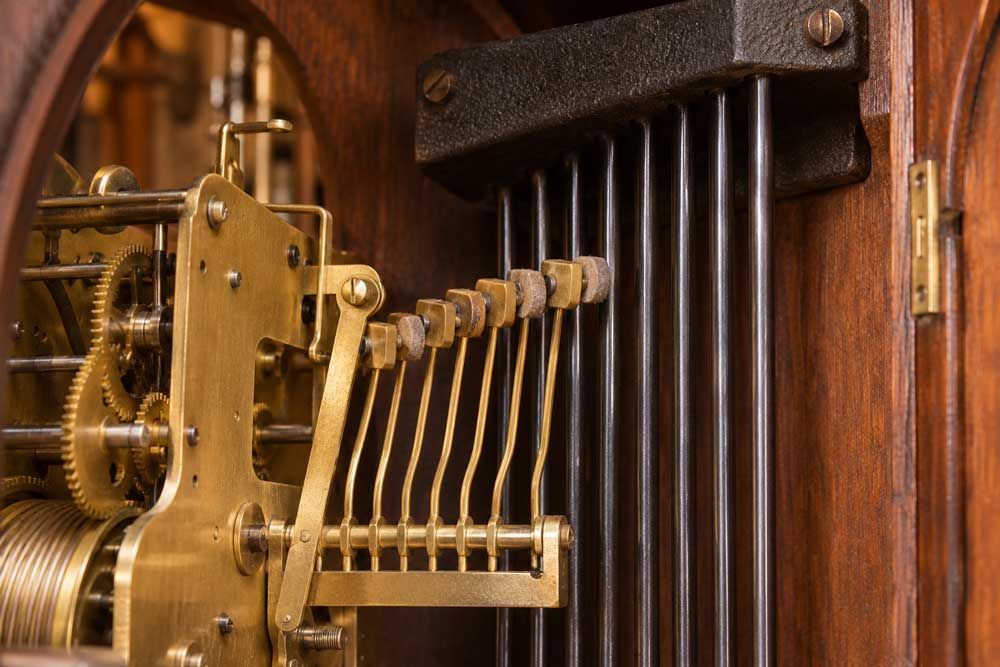
If your grandfather clock continues to drift after careful pendulum adjustments and leveling, the issue likely resides deeper in the movement. Worn gear pivots, dried lubricants, or a weak mainspring cannot be resolved by turning the rating nut, as these issues introduce internal resistance that disrupts the delicate transfer of energy through the gear train. Continuing to adjust a worn mechanism can mask a worsening condition. Wear takes a toll.
Several symptoms point clearly to a need for professional restoration rather than further self-adjustment:
- The pendulum swings for a few minutes and then stops, even after the clock has been wound.
- The clock remains inaccurate despite multiple careful adjustments to the rating nut over several days.
- The ticking sound is uneven or erratic, with one beat noticeably shorter or heavier than the other, indicating the movement is out of beat in a way that leveling alone has not resolved.
- The clock hands feel loose, skip, or slip when you attempt to set the time.
Forcing repeated adjustments when the underlying issue is mechanical wear does real damage over time. Each unnecessary manipulation of the pendulum assembly or the hands adds friction to components that are already laboring. A grandfather clock that has not been professionally cleaned and lubricated in many years is operating under duress. What presents as a simple timekeeping problem is often the first visible symptom of a movement that needs careful, unhurried restoration. Our family of master horologists approaches each timepiece as a preservation project rather than a transaction. The goal is always to return the clock to the condition it deserves, ensuring it continues marking time for the next generation.
Frequently Asked Questions About Clock Regulation
These frequently asked questions address the common mechanical and operational concerns that arise during grandfather clock regulation. Based on decades of experience in our Chicago workshops, these answers will help you securely maintain the delicate chime, time synchronization, and structural alignment of your heirloom timepiece.
How Do I Change the Time on My Howard Miller Clock?
Move the minute hand forward, always forward, stopping at each quarter-hour mark to allow the clock to complete its chime sequence before continuing. Forcing the hands past a chime point without letting the sequence finish can cause the strike train to fall out of sync with the dial. If you need to advance the time by several hours, work slowly and let each chime play out fully before moving the hand again. Never apply backward force to the minute hand if you feel resistance; resistance means the movement is mid-sequence and needs a moment to complete it before you continue. Patience prevents damage.
Why Is My Pendulum Clock Not Swinging?
A pendulum clock stops swinging for one of three reasons: the case is not level and the pendulum is dragging against the guide loops, the pendulum is not properly seated on its hanger at the top of the assembly, or the movement is out of beat and the escapement is not releasing the gear train evenly. Start by checking that the pendulum hook is fully engaged at the top, then verify the case is level on both axes. If the clock still stops after a few minutes of swinging, the beat adjustment likely needs attention from a master horologist.
How Do I Reset the Chimes on a Grandfather Clock?
Move the minute hand forward to the 12 o'clock position and allow the full chime sequence to complete. If the number of strikes does not match the hour shown on the dial, carefully move the hour hand independently, without touching the minute hand, to point to the correct hour. On most Howard Miller movements, the hour hand is friction-fit and can be repositioned with a light touch by hand. Once both hands are correctly aligned and the chime count matches the hour, the clock should maintain that synchronization going forward.
How Do I Adjust the Chimes on My Pendulum Clock?
Most Howard Miller grandfather clocks include a melody selection lever located on the dial face or along the side of the movement. This lever allows you to choose between available chime melodies, commonly Westminster, Whittington, and St. Michael, or to set the chime to silent. The lever positions are typically labeled; move it slowly and deliberately to the desired setting. If your clock has a night-silence feature, a separate lever or switch controls the hours during which the chime is suppressed, and its position is documented in your owner's manual.
Is It Okay to Move Clock Hands Backwards?
Moving the minute hand backward is generally not recommended, particularly on clocks with chiming or striking mechanisms, because reversing the hand can interfere with the cam system that triggers the chime train. Some modern Howard Miller movements are designed to tolerate limited backward movement of the minute hand, but the safest practice is to always advance the hands forward. If you are unsure whether your specific movement allows backward movement, consult your owner's manual before attempting it: a few seconds of verification is worth avoiding a misaligned strike train.
A grandfather clock that keeps accurate time is not just a functional object: it is evidence that someone cared enough to tend to it. Since 1917, our family at Chicago Clock Company has dedicated four generations of family ownership to the preservation and custodianship of heirloom timepieces. We understand that when you trust us with a clock, you are sharing a piece of your family's history. Whether your Howard Miller timepiece needs a seasonal pendulum calibration, a full movement restoration, or simply a careful assessment by a craftsman who has seen every variation of this problem, we are here to provide the meticulous, unhurried attention it deserves.
You are welcome to visit our workshops in Palatine at 1615 North Rand Road (847-359-5805) or in Orland Park at 14486 LaGrange Road (708-349-2565). Both locations are open Monday through Friday from 10 am to 6 pm and Saturday from 10 am to 5 pm.
To schedule an in-home service visit or to speak with one of our master horologists about your clock's specific condition, call our main office at 630 986 9210. Our family is available Monday through Friday from 10 am to 6 pm and Saturday from 10 am to 5 pm, and we are glad to help you keep your heirloom ticking for the generations ahead.