How to Set the Chime on a Grandfather Clock: Expert Guide
There is a distinct unease that settles over a room when a grandfather clock falls silent, or worse, when it strikes five times while the hands rest at four. These majestic timepieces are not decorative furniture. They are the heartbeat of a home, carrying the weight of family history in every measured tick and every resonant chime. When that voice goes wrong, the instinct to care for it yourself is entirely reasonable, and the fear of making things worse is equally understandable.
Many owners hesitate at the thought of touching the internal mechanism, worried that a misplaced finger or an impatient adjustment could bend a delicate rod or jam a gear that has been running faithfully for decades. That caution is worth honoring. But with the right sequence and a truly patient hand, most chime adjustments are well within reach for anyone willing to move slowly and listen carefully to what the movement is telling them.
At Chicago Clock Company, our family has been preserving these heirlooms since 1917, four generations of craftsmen who understand that restoring a grandfather clock's chime is as much about respecting the mechanism as it is about following the correct procedure.
Understanding Your Grandfather Clock's Chime Mechanism
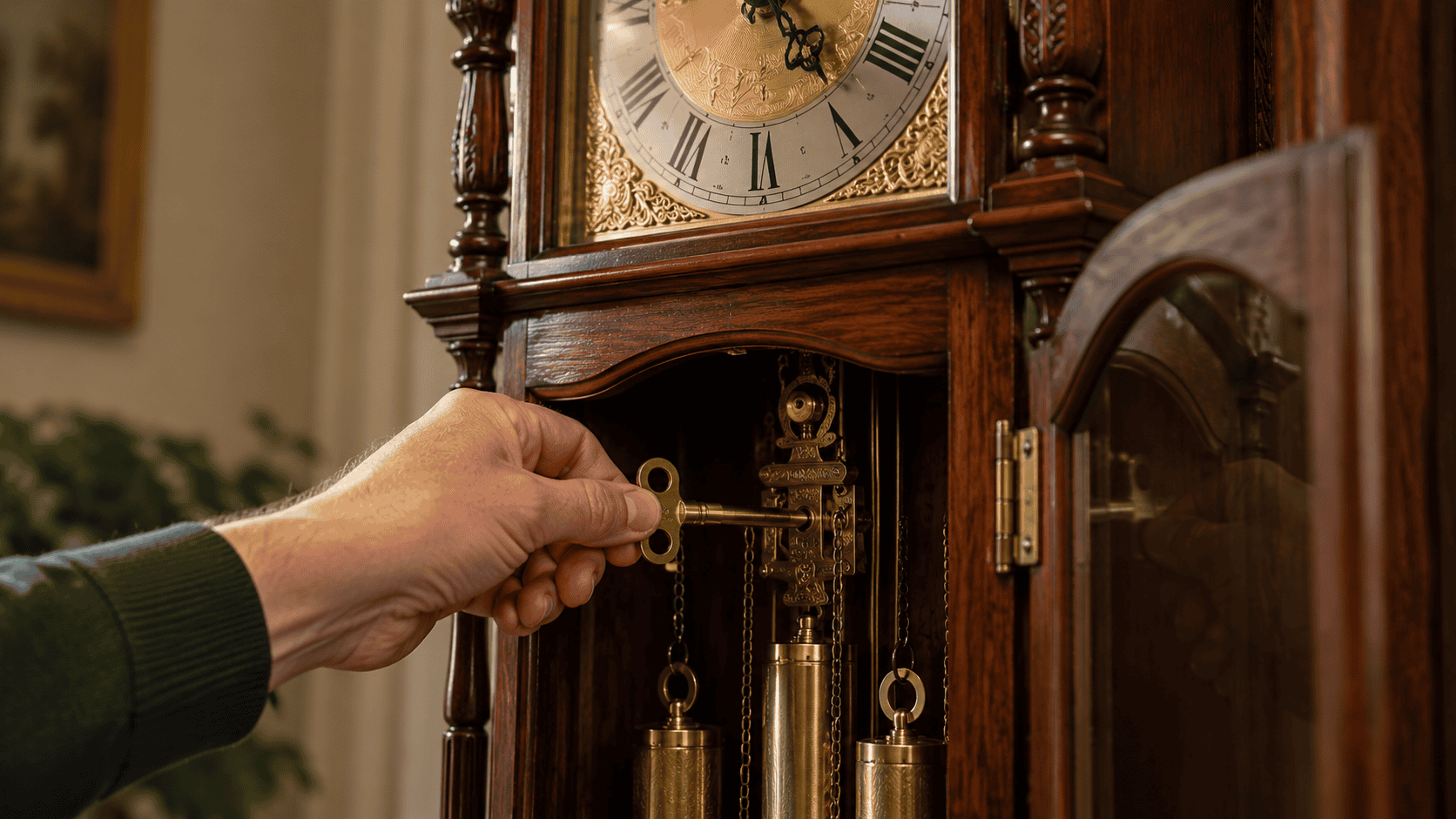
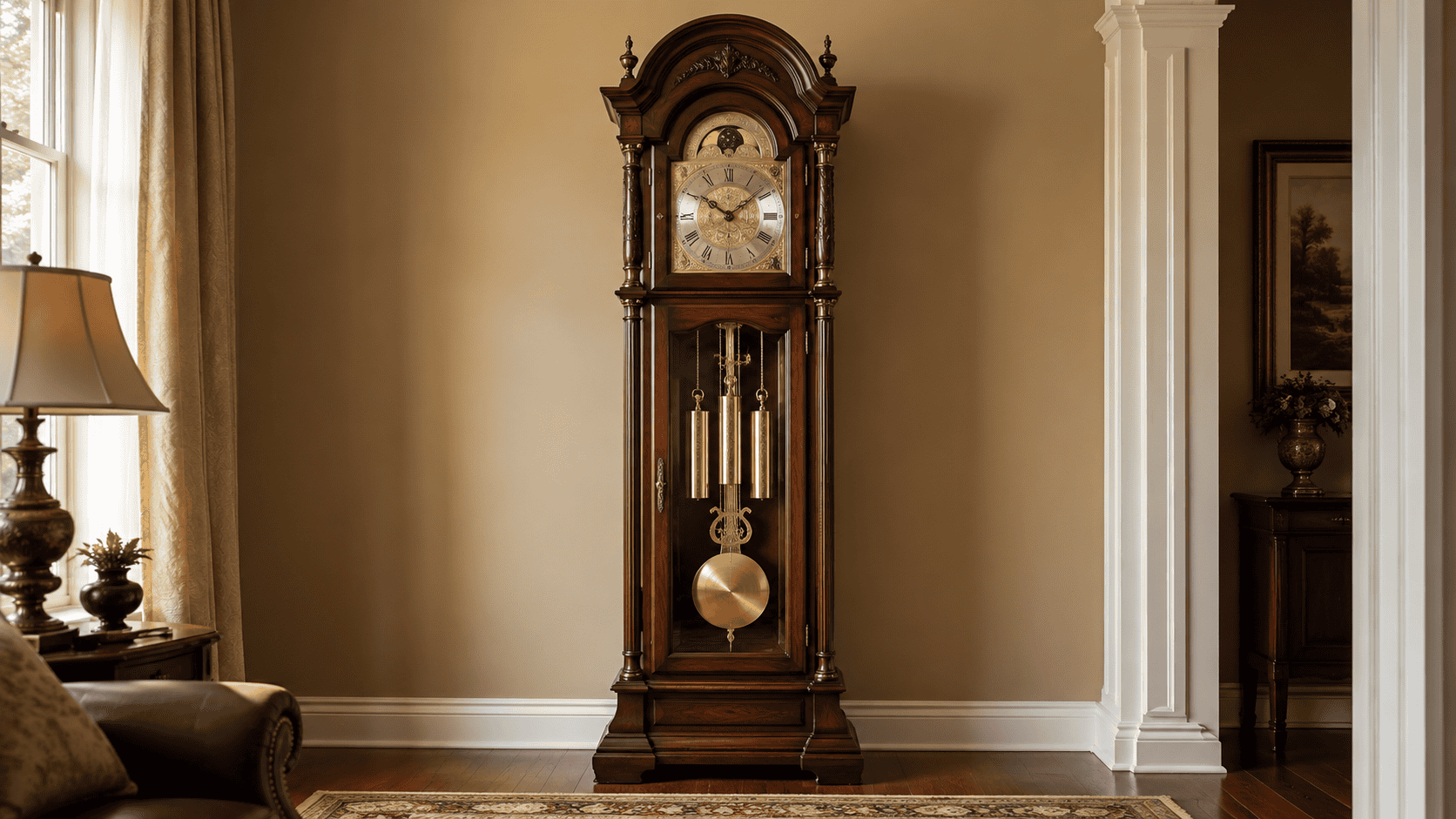
The chime in a grandfather clock does not operate independently of the rest of the movement. It draws its power from the same weighted gear train that drives the timekeeping, and the interaction between those systems is what makes the chime feel alive rather than mechanical. Three separate weights hang inside the cabinet, each with a dedicated function: one powers the going train that keeps the pendulum swinging and the hands advancing, one drives the strike train that counts the hours, and one energizes the chime train that plays the melody sequence at each quarter-hour. Hanging them in the wrong order, or allowing any one of them to run fully down, strains the entire system, not just the component that weight was meant to power.
The escapement regulates the tempo of all three trains, releasing energy in controlled increments as the pendulum swings. The chime melody itself is produced when the chime train lifts a series of chime rods via precisely positioned pins on a rotating barrel, causing small hammers to strike the rods in a specific sequence. The quality of that sequence, whether the melody sounds clean and resonant or dull and erratic, depends on hammer alignment: the relationship between the tip of each hammer and the surface of its corresponding rod. Even a slight drift in that alignment changes the character of the sound. Precision is everything. Understanding the history of longcase clocks reveals how these mechanical principles evolved over centuries, with each generation of craftsmen refining the geometry of the strike train to produce the warm, layered tones we associate with traditional grandfather timepieces today.
The dial plate carries more information than most owners realize. Look closely. On the majority of three-weight movements, a selector lever sits near the 3 o'clock or 9 o'clock position on the dial face. This lever physically shifts a component within the gear train, either routing the movement's energy toward a specific melody sequence or disengaging the chime train entirely when moved to the "Silent" position. The lever works through direct mechanical contact, which means forcing it while the movement is mid-cycle can cause the pins to bind against the hammer-lifting mechanism. Careful handling of mechanical clock movements is essential here: these are not digital systems with error recovery; a bent pin or a jammed lever requires hands-on correction. Each of the three weights must also hang in its designated position. The exact weight differential between them varies by manufacturer and movement design, so rather than relying on feel alone, consult your movement's documentation or look for any markings on the weight shells that indicate their assigned position.
How to Set and Adjust the Chime Melody Selector
Most traditional grandfather timepieces offer a choice of three melodies: Westminster, Whittington, and St. Michael's. Westminster is the most widely recognized: its four-phrase sequence descends from the Great Bell of Westminster Abbey and has been the standard for longcase movements since the nineteenth century. Whittington draws from the bells of St. Mary-le-Bow in London, with a lighter, more cascading character. St. Michael's carries a dignified, hymn-like quality that suits movements with a deeper, more resonant set of chime rods. Each melody is encoded in the pin pattern on the chime barrel, and the chime selector lever routes the hammer-lifting mechanism to engage the correct set of pins when you move it to the corresponding position.
The essential rule of chime adjustment is simple: never touch the Westminster chime settings lever, or any melody selector, while the movement is actively chiming or within fifteen minutes of an upcoming quarter-hour strike. During that window, the chime train is already engaged and advancing toward its trigger point. Patience is required. Shifting the lever mid-cycle forces the pin barrel into a position it was not mechanically prepared for, which can jam the lifting arms or cause the hammer sequence to skip entirely. Waiting until the minute hand has cleared the quarter-hour position by a comfortable margin gives the gear train time to fully complete its cycle and return to a neutral position, making melody synchronization a smooth transition rather than a forced one.
- Wait for the clock to finish chiming completely and confirm the minute hand is at least fifteen minutes away from the next quarter-hour mark.
- Locate the melody selection lever on the right side of the dial face, typically near the 3 o'clock position.
- Slowly slide the lever to your desired setting, Westminster, Whittington, or St. Michael's, until you feel it seat fully into its detent. A partial engagement between two settings is a common source of erratic or incomplete melodies.
- If the lever feels stiff or resists movement, do not force it. Allow the clock to advance past the next strike cycle and try again; stiffness often means the pin barrel has not fully cleared its previous position.
- Allow the movement to run through one complete hour cycle so the internal gear train can align itself with the newly selected melody sequence before you evaluate the sound.
If your melody selector lever is completely stuck or the timepiece fails to play the selected tune after a full hour of operation, the issue likely lies deeper in the chime train than a simple lever adjustment can address. Our family at Chicago Clock Company has provided expert in-home grandfather clock repair across the Chicago area since 1917. Let our master craftsmen restore the quiet heartbeat of your timepiece. We can help. Contact us today at 630 986 9210 to schedule a convenient in-home visit.
Step-by-Step Guide to Synchronizing the Chime with the Hands
When a grandfather clock chimes four times while the hands point to five, a synchronization gap has opened between the visual display and the mechanical strike train. These two systems run in parallel, and under normal conditions they stay coupled through the movement's own gear geometry. After a power interruption (weights running fully down), a move to a new location, or an accidental manual hand adjustment, the coupling can drift. The visual face says one thing; the strike train remembers something different. They are out of sync. Treating this as a preservation task rather than a mechanical chore changes how you approach it: you are not correcting a fault; you are realigning two parts of the same instrument. Consistent attention to grandfather clock maintenance is what prevents this drift from becoming a recurring problem.
The mechanical explanation is worth understanding before you touch anything. It is quite simple. The strike train alignment depends on a count wheel or rack-and-snail mechanism (depending on the movement's design) that advances by one position each time the clock strikes. If the hands were moved backward, or if the movement stopped mid-cycle, the count mechanism may have advanced to a position that no longer corresponds to what the hands are displaying. Correcting it manually is a matter of moving the hour hand independently: it sits on a friction-fit collet and can be repositioned without disturbing the minute hand or the gear train. Most modern movements also incorporate a self-correcting mechanism that will gradually realign the strike count over a few hours of continuous operation, though the exact duration varies by movement design and manufacturer. If the misalignment is substantial, more than two or three hours off, manual correction is faster and puts less cumulative stress on the count mechanism than waiting for automatic correction.
- Allow the clock to strike the hour and count the number of chimes carefully. Do not assume; count each strike as it sounds.
- If the clock strikes five times but the hands point to four, carefully grasp the hour hand near its center collet, the short, wide hand, and rotate it independently until it points directly to five, matching the strike count you heard.
- Once the hour hand reflects the strike count, use the minute hand to advance the time to the correct current time. Move the minute hand clockwise only, pausing fully at each quarter-hour position to allow the chime sequence to complete before continuing.
- Never move the minute hand counterclockwise. Doing so can stress the cannon pinion and disrupt the count mechanism you just corrected.
- Observe the timepiece over the next two hours to confirm that the visual time and the auditory strikes remain aligned. If they drift again, the count mechanism may need professional attention.
Troubleshooting Silent or Malfunctioning Chimes
A grandfather clock that keeps accurate time but produces no chime sound at all is telling you something specific: the going train is functional, but the chime train has been interrupted somewhere between the weight and the hammers. Before assuming the movement needs professional attention, work through the most common causes in order of likelihood.
Start with the chime shut-off lever. On most movements, this lever, sometimes labeled "Silent," "Night Off," or "Chime/Silent," sits on the dial face and can be nudged into the off position without the owner realizing it. A bump during dusting or a curious hand is all it takes. If the lever is fully in the "Silent" position, the chime train is mechanically disengaged regardless of how well everything else is functioning.
Move it to the active chime position and allow the movement to complete a full quarter-hour cycle before drawing any judgments. Weight synchronization is the next check: confirm that all three weights are fully wound and hanging in their correct positions. A chime weight that has run to the bottom of its travel cannot lift the hammers, even if the other two weights are providing sufficient power to the going and strike trains. Finally, examine hammer alignment through the side access panels if your cabinet has them. A hammer that has drifted until it rests directly against its chime rod will produce a muffled buzz or no sound at all, because the rod cannot vibrate freely when it is in constant contact with the hammer tip.
When basic troubleshooting steps do not restore the soft chime of your heirloom, it may be time for professional custodianship. We are here. Since 1917, Chicago Clock Company has been the trusted guardian of Chicagoland's horological treasures. We provide expert grandfather clock repair services directly in your home, eliminating the risk of transporting your delicate timepiece. Contact our fourth-generation family workshop today at 630 986 9210 to bring the heartbeat of your timepiece back to life.
Adjusting Chime Volume and Hammer Alignment
Physical hammer adjustment is one of the more satisfying acts of care an owner can perform, because the feedback is immediate and distinctive. A properly aligned hammer produces a clean, resonant strike that decays naturally; a misaligned one produces a dull thud, a buzzing sustain, or silence. The adjustment itself requires nothing more than a careful, controlled bend of the thin brass hammer shank, but "careful" carries real weight here, because brass weakens with repeated bending and a shank that has been worked back and forth too many times will eventually crack.
- Open the side access panels or carefully remove the hood of the clock cabinet to expose the chime hammers and the vertical metal rods they strike.
- Inspect the relationship between each felt- or leather-tipped hammer and its corresponding rod. You are looking for a very slight clearance: enough that the hammer can swing freely, strike the rod cleanly, and immediately rebound without resting against it. The exact gap varies by movement design, so focus on the behavior rather than a fixed measurement.
- If a hammer is resting directly against a rod when the movement is idle, it will dampen the rod's vibration and produce a buzzing or muted tone. Slowly bend the thin brass shank slightly backward, away from the rod, to create that small clearance.
- If the chime sounds too quiet, the hammer may be traveling too far from the rod before striking, reducing the force of impact. Slowly bend the shank slightly closer to the rod, stopping well before the hammer makes contact at rest.
- Test each hammer by softly lifting it manually and releasing it against the rod. A clear, singing tone that sustains for a moment before fading indicates correct alignment. A thud or buzz means the gap needs further refinement.
Mechanical timepieces are genuinely sensitive to their surroundings in ways that owners sometimes underestimate. In the Chicago area, seasonal humidity swings cause the wooden cabinet to expand and contract measurably across the year, and that movement can shift the chime rods relative to the hammers by enough to alter the tone or introduce a new buzz that wasn't present six months ago. This is not a sign of deterioration, but simply the nature of a wooden case responding to its environment. Wood breathes. What matters is that the movement itself receives professional cleaning and oiling on a regular schedule. Most horologists recommend a thorough preservation cycle every five to seven years, which clears the accumulated debris from the pivot holes, replenishes the lubricants that keep the strike train lifting the hammers with consistent force, and catches any developing wear before it becomes a costly restoration.
Skipping that cycle does not just affect the chime; it gradually compromises the monetary and sentimental value of the entire heirloom.
Many minor chime adjustments can be made with patience and a careful hand, but some issues, worn pivot holes, a cracked chime barrel, a fatigued hammer shank, require the specialized tools and diagnostic experience of a master horologist who has worked inside hundreds of these movements. We are ready.
Frequently Asked Questions About Grandfather Clock Chimes
How do I get my grandfather clock to chime the correct time?
Wait for the timepiece to strike the hour and count the beats carefully. Carefully grasp the hour hand near its center collet and move it independently to point to the number of strikes you heard. Then advance the minute hand clockwise to the correct current time, pausing at each quarter-hour to let the chime sequence complete fully before continuing. For more essential guidance on caring for your timepiece, explore our grandfather clock care tips.
How do I reset the chimes on my grandfather clock?
Start by verifying that the chime selector lever is fully seated in a melody position, Westminster, Whittington, or St. Michael's, and not caught between two settings or resting in the "Silent" position. If the movement has run down, wind all three weights fully and confirm they are hanging in their correct positions. Set the time by advancing the minute hand clockwise, allowing the chime to play completely at each quarter-hour. Most movements will realign the strike cycle automatically within a few hours of continuous operation, though a significant misalignment is faster to correct manually using the hour hand method described above.
How do you restore the chimes on a grandfather clock if they won't play at all?
Confirm that the weights are fully wound and positioned correctly: the weight that powers the chime train is typically on the right side as you face the timepiece, though this varies by manufacturer, so verify against your movement's documentation. Check that the chime hammers are not bent or resting directly against the chime rods, which would dampen any vibration. Verify that the selector lever is not in the "Silent" or "Night Off" position. If all three of those checks come back clean and the chimes remain silent, the issue is likely internal to the movement and warrants professional attention.
Do all grandfather clocks chime every 15 minutes?
Not all of them. Many traditional three-weight movements feature Westminster, Whittington, or St. Michael's melodies that play a progressive sequence at each quarter-hour, building to the full melody at the top of the hour. Some vintage or specialized timepieces strike only at the hour, with no quarter-hour chime at all. Others carry a manual or automatic night-silencing feature that mutes the chime during a set window of hours, which can create the impression that the movement has stopped chiming when it is simply following its programmed schedule.
Why is my grandfather clock chiming the wrong melody?
The most common cause is a chime melody selector lever that has been bumped or left partially between two settings. It is easily bumped. When the lever sits in a transitional position rather than fully seated in a detent, the pin barrel engages an incomplete or hybrid sequence that does not correspond to any of the intended melodies. To correct it, slowly slide the lever fully into the detent of your chosen melody while the timepiece is not chiming, then allow the movement to run through a complete hour cycle so the gear train can finish its automatic alignment with the new selection.
Reach Out to Us Today
Setting and adjusting the chimes on your grandfather clock is a genuine act of connection: with the mechanical artistry of the craftsmen who built it and with the generations of your family who have listened to it mark the hours. They connect generations. These timepieces carry family histories in their movements, and their rhythmic chimes provide a continuity that no digital device can match. When simple adjustments are not enough to restore that voice, trusting the work to experienced professionals ensures the legacy continues to tick for the generations still to come. At Chicago Clock Company, every timepiece that comes into our care receives the same reverence and meticulous attention that Jason Matthiesen, Louie Matthiesen, Conrad Utecht, Ludwig Matthiesen, and Andrew Matthiesen have brought to this craft across more than a century of family custodianship.
Whether your heirloom grandfather clock requires a delicate chime adjustment, a complete mechanical restoration, or routine preservation, our family is here to help. We invite you to contact Chicago Clock Company today at 630 986 9210 or visit our showrooms in Orland Park (14486 LaGrange Road, 708-349-2565) or Palatine (1615 North Rand Road, 847-359-5805). Let our fourth-generation master craftsmen preserve the heartbeat and soft chime of your family's history.