Best Desk & Table Clocks for Home Offices
The best desk clocks for office environments balance silent mechanics with considered aesthetics that make a workspace feel intentional, not assembled. If you spend your days in a home office, you already know the steady friction of checking your phone every twenty minutes. Each glance pulls you out of whatever you were building mentally, and the cost accumulates. Focus suffers. A well-chosen physical timepiece addresses that problem directly, offering screen-free productivity without adding visual noise to your desk. It becomes the heartbeat of your home office, a quiet anchor in a busy day. It anchors your day. Choosing such an object is a deliberate act of home office curation, the idea that the things surrounding your work should be chosen with the same patience you bring to the work itself. That philosophy sits at the center of horological craftsmanship, the centuries-old discipline of making instruments that measure time faithfully and endure beautifully.
The science of silent focus: why clock movement matters in your office
Most people who have worked near a cheap quartz clock understand the problem intuitively: that sharp, mechanical tick lands at exactly the wrong moment during a call or a long stretch of concentrated writing. Traditional stepping quartz movements advance the second hand in distinct, audible jumps, each one a small percussion event. In a quiet room, that rhythm becomes a presence you cannot ignore, and auditory distractions of that kind are well-documented obstacles to sustained concentration. The issue is not volume so much as regularity; the brain is wired to track rhythmic sound, which means a ticking clock competes directly with the cognitive resources you need for deep work.
A quiet-sweep quartz movement solves this by driving the second hand in a continuous, fluid arc rather than a series of steps. The gears advance in micro-increments, producing no perceptible click. Silence is immediate. Think of it the way a well-oiled hinge swings without protest compared to one that has been neglected: the mechanism is doing the same work, but the care taken in its construction removes the friction that would otherwise announce itself. Premium manufacturers engineer these movements to tolerances that mass-market alternatives simply do not bother with, and the difference is immediately apparent when you hold a quality piece in a quiet room. The movement breathes rather than ticks, and your office stays acoustically clean.
Many remote professionals avoid analog clocks because they assume all mechanical movements are noisy. That reputation belongs to inexpensive movements, not to the category as a whole. Quality changes everything. A well-constructed sweep movement from a reputable maker emits nothing more than a faint, ambient hum, less intrusive than a laptop fan. Choosing a silent movement is not a luxury upgrade; for anyone who takes their focus seriously, it is a structural decision about the acoustic character of their workspace.
Atomic Precision: Understanding Radio-Controlled Desk Clocks
The term "atomic clock" gets applied loosely to a wide range of consumer timepieces, and the distinction matters. Precision is key. According to the NIST WWVB Radio-Controlled Clocks Guide, what the market calls atomic clocks are radio-controlled clocks, devices fitted with miniature radio receivers permanently tuned to a low-frequency 60 kHz signal broadcast by the National Institute of Standards and Technology from radio station WWVB near Fort Collins, Colorado. Because there is no atomic oscillator inside the case, what you are receiving is a clock that synchronizes with one. Between those daily synchronizations, the clock relies on internal quartz crystal oscillators that typically hold time to within one second over a few days. For a home office, that level of precision is more than sufficient, and the automatic synchronization means you never need to adjust it manually after a power outage or battery swap.
The precision ceiling of this technology is genuinely impressive. It is unmatched. Research documented in the NIST Legacy Time Synchronization Study shows that clocks phase-locked to low-frequency standard broadcasts can maintain synchronization with the national time scale to within 10 microseconds. That figure is academic for most desk applications, but it reflects the underlying integrity of the WWVB signal and explains why radio-controlled movements have become the standard for precision consumer timekeeping. On the energy side, a typical living room clock draws approximately 2.98 W (per the NIST Technical Note 1767), making these clocks an essentially minor addition to your home office's electrical load. To see how this radio wave reception technology scales up to a larger format, the radio-controlled wall clock from Chicago Clock Company illustrates the same synchronization principles in a wall-mounted form factor.
The practical advantages of a radio-controlled desk clock for daily office use come down to three things:
- Absolute accuracy: The clock displays the correct time to the exact second by synchronizing with national standards.
- Automatic DST adjustment: Daylight Saving Time transitions happen without any manual intervention, twice a year, with complete ease.
- Backup reliability: When the WWVB signal is temporarily unavailable, the clock reverts to its internal quartz oscillator and maintains high accuracy until the next successful synchronization.
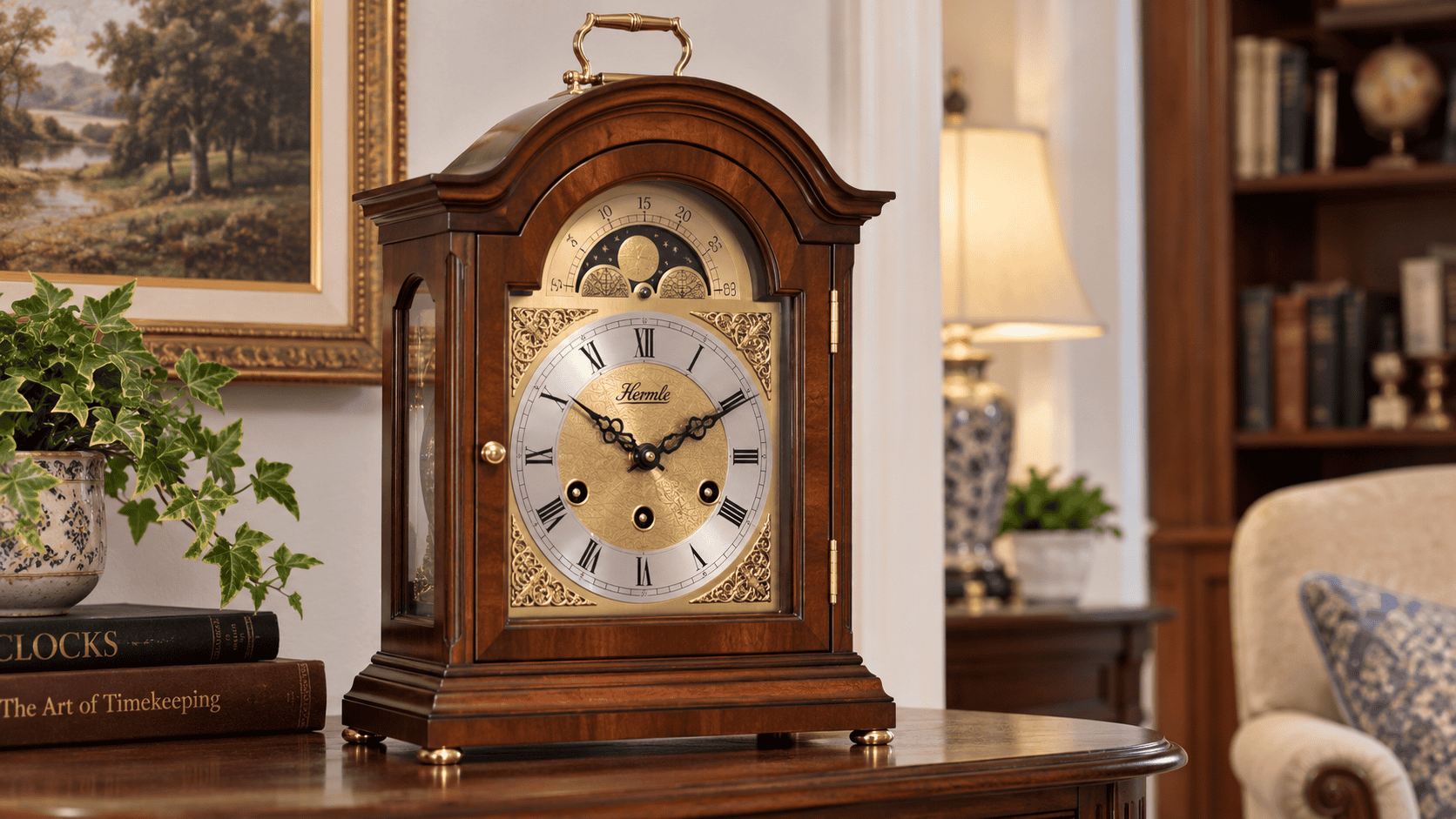
Discover the Palmero 645-769 tabletop clock, a quiet, elegantly styled timepiece that brings classic craftsmanship to the modern desk. Our family at Chicago Clock Company has been a custodian of fine horology since 1917, and pieces like the Palmero reflect that lineage: furniture-grade construction, a movement engineered for silence, and a presence on your desk that earns its place.
Overcoming signal interference and placement challenges in the home office
Radio-controlled clocks do not maintain a continuous connection to the WWVB transmitter. They synchronize once per day, typically around midnight or in the early morning hours, because the 60 kHz low-frequency signal travels most reliably when the entire propagation path between Fort Collins and your clock is dark. During daylight hours, atmospheric conditions weaken the signal significantly. The signal fades. This means the clock you place on your desk is quietly doing its most important work while you sleep, and by the time you sit down in the morning, it has already corrected itself. The challenge is ensuring that signal synchronization can reliably occur when the clock attempts it. Electrical noise is the primary obstacle in a home office: some computer monitors operate at scan frequencies at or near the 60 kHz carrier frequency of the WWVB signal, which can swamp the receiver entirely. Physical shielding is a secondary concern; metal roofs, steel siding, and the steel-framed construction common in urban Chicago buildings can all block the signal before it reaches the clock's antenna. Electromagnetic interference from routers, monitors, and other active electronics compounds the problem in densely equipped workspaces.
Placement and orientation solve most of these issues without any technical intervention. Simple adjustments work. Because the internal antennas in radio-controlled desk clocks are highly directional, rotating the unit 90 degrees can dramatically improve reception when the initial synchronization fails. The transmitter sits in Fort Collins, Colorado, so positioning your clock near a west-facing window gives the signal the clearest possible path. Keeping the clock at least 1 to 2 meters from your monitors and router removes the most common interference sources. For Chicago-area offices in steel-framed buildings, window placement is not optional: it is the difference between a clock that synchronizes nightly and one that drifts for weeks.
A quick-reference checklist for optimal placement:
- Distance: Keep the clock at least 1 to 2 meters away from computer monitors, routers, and other active electronics.
- Orientation: If the clock fails to synchronize, rotate it 90 degrees to reorient the directional internal antenna toward the transmitter.
- Path: Position the clock near a west-facing window to maintain a clear signal path toward Fort Collins, Colorado.
- Offset: Confirm the clock is set to the correct local time zone offset, where Central Standard Time requires -6 hours from UTC, and Central Daylight Time requires -5 hours.
Aesthetic integration: matching clocks to your office decor
A clock that looks wrong on your desk will bother you more than you expect. Design choices matter. Furniture-grade aesthetics matter here not as a luxury consideration but as a functional one: an object you interact with visually dozens of times a day should contribute to the room's coherence rather than disrupt it. Different finishes serve different environments. An antique black finish with rustic detailing reads naturally against the exposed brick and industrial metal of a converted Chicago timber loft; it does not fight the room, it completes it. Warm gray hardwoods and Seaside Gray finishes, on the other hand, align with the built-in wooden shelving of a traditional bungalow or a stripped-back minimalist study, where the grain and warmth of the wood carry the aesthetic weight without demanding attention. The tactile quality of a furniture-grade wooden mantel clock, perhaps one day to be passed down through generations as a cherished family heirloom, is something no plastic digital screen can replicate, as there is a warmth and weight to it that signals permanence rather than disposability. Transitional design, which includes timepieces that bridge classic craftsmanship and contemporary workspace sensibility, tends to work across the widest range of interiors, which is why it dominates the premium desk clock category.
Choosing your display: analog elegance vs. digital clarity
The analog versus digital question involves more than personal taste: there are genuine functional trade-offs worth understanding before you buy:
- Readability and signal status: Digital models display signal-reception indicators directly on screen, making it easy to confirm the clock has successfully synchronized.
- Physical alignment risk: Analog desk clocks are prone to hand misalignment from factory assembly or shipping, which can cause them to show the wrong time by a second or more even when the internal receiver has synchronized correctly. This is a known limitation, not a rare defect. Expect minor drift.
- Audio signals: Some analog radio-controlled models use audio beeps or tones rather than visual icons to signal reception, which requires a different kind of user awareness than a glanceable screen indicator.
- Aesthetic character: Analog faces carry a sense of heritage and horological tradition that digital screens simply do not replicate. For readers weighing a contemporary digital format, the Nikita digital wall clock offers a useful reference point for how a well-designed digital display can hold its own aesthetically against traditional analog dials.
Time zone configuration deserves careful attention before purchasing. Settings matter. Radio-controlled clocks receive UTC synchronization, which is Coordinated Universal Time, and depend entirely on user-configured offsets to display local time correctly. Time zone correction for Chicago is -6 hours during Central Standard Time and -5 hours during Central Daylight Time. Some entry-level models restrict selection to only the four major continental US time zones, Pacific, Mountain, Central, and Eastern, which covers most buyers but excludes anyone in a non-standard zone. More critically, users in regions that do not observe Daylight Saving Time need a clock with a manual DST toggle; without it, the clock will automatically shift twice a year regardless of local practice.
Frequently asked questions about office desk clocks
What is the best brand for table clocks?
For those seeking a blend of precision, craftsmanship, and aesthetic variety, brands like Howard Miller and Seiko are widely considered the leading choices. We frequently highlight how these historic manufacturers combine furniture-grade wood cases with highly reliable quartz movements to create timepieces that serve as both functional timekeepers and beautiful office decor.
What is the coolest desk clock for a modern office?
The QLOCKTWO Touch is frequently celebrated as one of the coolest desk clocks due to its unique, word-based time display and minimalist design. Instead of hands or numbers, it uses a grid of illuminated letters to spell out the time, making it a striking conversation piece for modern and contemporary home workspaces.
What are the best wall clocks for a professional office?
Mondaine and Braun are highly recommended for professional office environments. They deliver clarity. Both brands prioritize clean, high-contrast, and minimalist designs that offer exceptional readability from across a room, ensuring your workspace remains organized and efficient without visual clutter.
Who is considered the best clock manufacturer in the industry?
Hermle and Howard Miller are widely regarded as the finest clock manufacturers in the industry. Their quality endures. They are celebrated for their mechanical precision, long-standing history of high-end clock production, and dedication to preserving traditional horological craftsmanship across generations.
Explore Our Collection Today
Selecting the right desk clock is a genuine investment in your daily focus and the character of your workspace, not a minor purchasing decision. A well-chosen timepiece from a trusted maker will sit on your desk for decades, keeping faithful time and lending the room a quiet authority that no screen can match. Browse our curated collection of Chicago Clock bestsellers to find a timepiece that brings quiet harmony and timeless style to your desk.
Ready to curate your workspace? Explore the full tabletop collection online or reach out to us at one of our showrooms for a personal consultation. At Chicago Clock Company, every timepiece we carry has been selected with the same care we would give to a piece in our own homes, because we believe that the objects you surround yourself with during your working hours shape the quality of the work itself. Your desk deserves a clock that keeps time faithfully and holds its place beautifully, year after year.