How to Date an Antique Clock by Its Movement
Learning how to date an antique clock by movement can help you uncover when a timepiece was made, where it may have originated, and whether its internal mechanism matches its case. Although decorative details provide useful clues, the movement often contains the strongest evidence of a clock’s age. Maker’s marks, construction techniques, materials, serial numbers, and mechanical features can all help narrow the manufacturing period.
Dating an antique clock is rarely as simple as finding a single stamped year. Clockmakers frequently used the same movement designs for decades, and many antique clocks have been repaired or modified during their lifetimes. A careful evaluation should therefore combine movement analysis with research into the dial, case, hardware, and provenance.
What Is an Antique Clock Movement?
The movement is the clock’s internal mechanical system. It controls timekeeping and, when applicable, functions such as striking, chiming, alarms, calendars, or moving figures.
A mechanical clock movement typically includes:
- Plates that support the internal components
- Gears and pinions that transfer energy
- An escapement that regulates the release of energy
- A pendulum or balance wheel that controls timing
- Springs or weights that power the mechanism
- A strike or chime system in clocks with sound functions
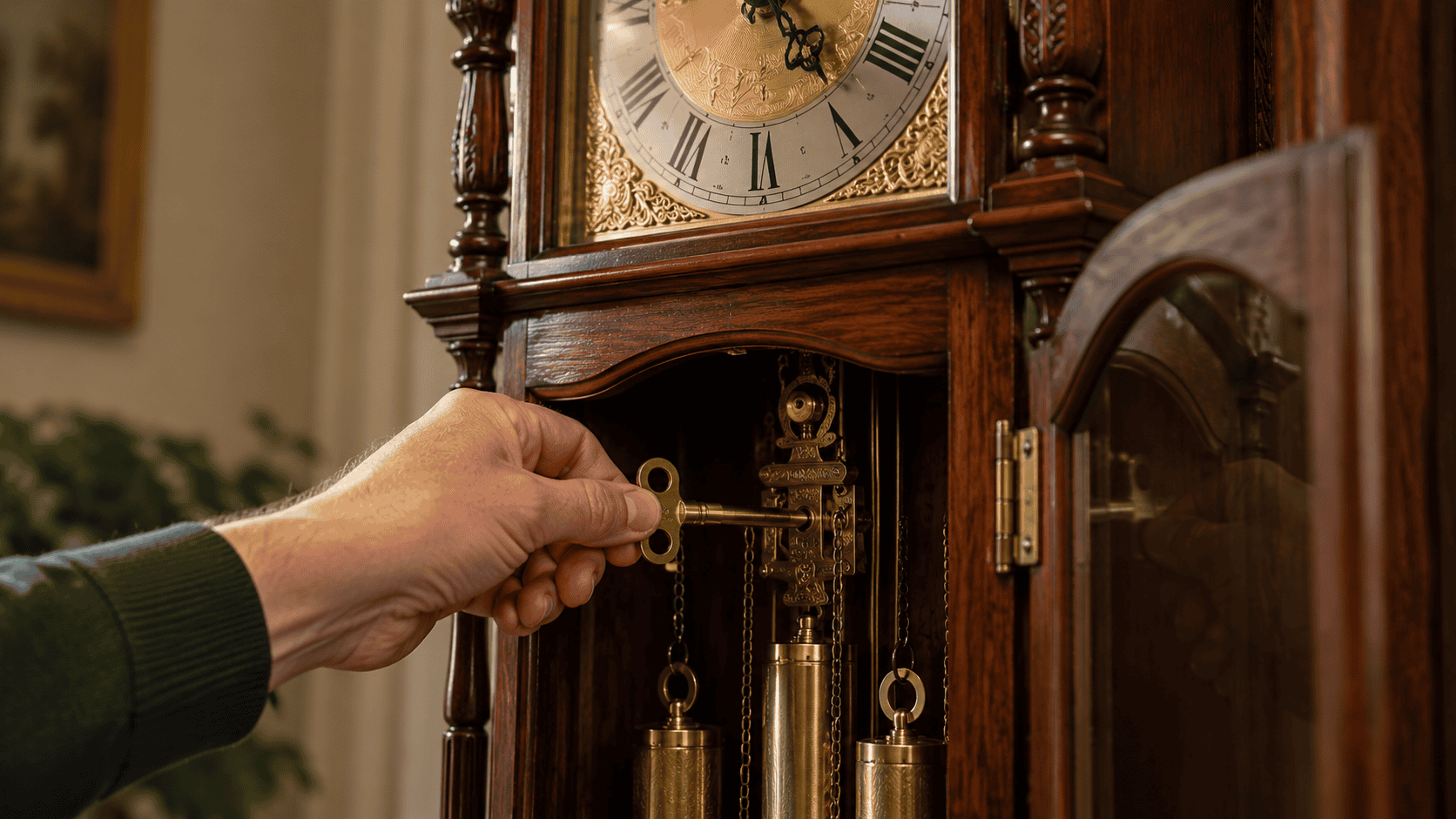
- Winding arbors or chains used to supply power
The movement can be thought of as the clock’s engine. Because movement design changed as tools, manufacturing methods, and consumer preferences evolved, its construction can reveal important information about the clock’s age.
Why the Movement Is Important When Dating a Clock
Clock cases were sometimes updated, replaced, or reused. A valuable movement could be installed in a newer case, while an older case might receive a replacement mechanism after the original movement became damaged.
The movement may provide evidence that is less dependent on changing decorative trends. It can reveal:
- The manufacturer or clockmaker
- A possible country or region of origin
- Whether the mechanism was handmade or mass-produced
- The type of power source
- The clock’s striking or chiming arrangement
- Construction methods associated with a particular period
- Patent dates or serial numbers
- Signs of replacement, restoration, or alteration
The movement should not be examined in isolation. The most reliable date usually comes from comparing movement evidence with the rest of the clock.
Begin With a Careful Visual Inspection
Before handling an antique clock, place it on a stable, protected surface. Do not force open a case or remove tightly fitted components. Some clocks have fragile glass, delicate hands, heavy weights, or unstable internal assemblies.
Use a flashlight to examine the back or underside of the movement. Depending on the clock’s design, you may be able to see identifying information without removing the movement from the case.
Look for:
- Names
- Initials
- Logos
- Symbols
- Serial numbers
- Patent information
- Country-of-origin marks
- Retailer names
- Handwritten repair dates
- Service labels
Record every mark exactly as it appears. Similar maker names may have been used by different companies, and small differences in logos can indicate different periods.
Taking clear photographs is often safer than repeatedly moving the clock. Photograph the entire clock, the dial, the back of the case, the movement, the movement stamp, the pendulum, the weights, and any labels.
Find and Research the Maker’s Mark
A maker’s mark is one of the most useful starting points when determining a clock’s age. It may be stamped, engraved, cast, printed, or scratched into the movement.
Common locations include:
- The back movement plate
- The front plate behind the dial
- The lower edge of the mechanism
- The bell support
- The pendulum leader
- The inside of the case
A mark may identify the movement manufacturer rather than the company named on the dial. Historically, some retailers and clock companies purchased movements from outside suppliers and sold the completed clocks under their own names.
Once you identify a mark, compare it with reliable manufacturer histories, trademark references, catalogs, museum records, and collector guides. Determine:
- When the company operated
- When it used that particular logo
- Whether it changed names or ownership
- Where its factories were located
- Which movement types it produced
- Whether serial-number records survive
A company’s operating dates establish a possible range, but they do not automatically identify the exact year of manufacture.
Use Serial Numbers With Caution
Serial numbers can be extremely helpful when accurate production records exist. Some manufacturers maintained chronological number sequences that allow collectors or specialists to estimate a production year.
However, a serial number is not always a date code. It may refer to:
- A movement model
- A production batch
- A factory department
- A case style
- A parts series
- A patent or design number
- An internal assembly code
Never assume that a four-digit number represents a year. Verify the number against records associated with the correct manufacturer. A serial-number chart for one company cannot be applied to another company’s movement.
Also, check whether the case, movement, pendulum, dial, or other components carry matching numbers. Matching assembly numbers can support the conclusion that the parts were originally fitted together, although they may not reveal the clock’s date by themselves.
Examine How the Movement Was Constructed
The method used to build a movement can help distinguish earlier workshop production from later industrial manufacturing.
Handmade Characteristics
Earlier movements may show:
- Irregular file marks
- Slightly uneven component shapes
- Hand-cut gears
- Individually fitted parts
- Hand-engraved lettering
- Variations in screw size or finish
- Tool marks left by manual production
These characteristics do not automatically prove that a clock is exceptionally old. Skilled craftspeople continued to use traditional methods after machine production became common.
Machine-Made Characteristics
Later movements often display:
- Uniform gear teeth
- Standardized screws
- Consistent plate shapes
- Repeated factory markings
- Interchangeable components
- Smooth and regular finishes
- Model numbers used across multiple clocks
Mass production expanded dramatically during the nineteenth century, but its adoption varied by country and manufacturer. Construction quality should therefore be interpreted alongside other evidence.
Study the Movement Plates
Many mechanical movements are built between metal plates. The shape, thickness, spacing, and material of those plates can provide useful clues.
Possible plate configurations include:
- Full-plate movements
- Three-quarter-plate movements
- Open-frame movements
- Posted-frame movements
- Skeletonized movements
- Round movements
- Rectangular movements
Brass became widely used because it resists corrosion and can be machined precisely. Earlier movements may include iron components or combinations of iron and brass. Later factory movements generally show greater uniformity in plate thickness, hole placement, and component layout.
Do not date a clock from plate material alone. Brass and iron were used over long periods, and replacement parts may differ from the originals.
Identify the Clock’s Power Source
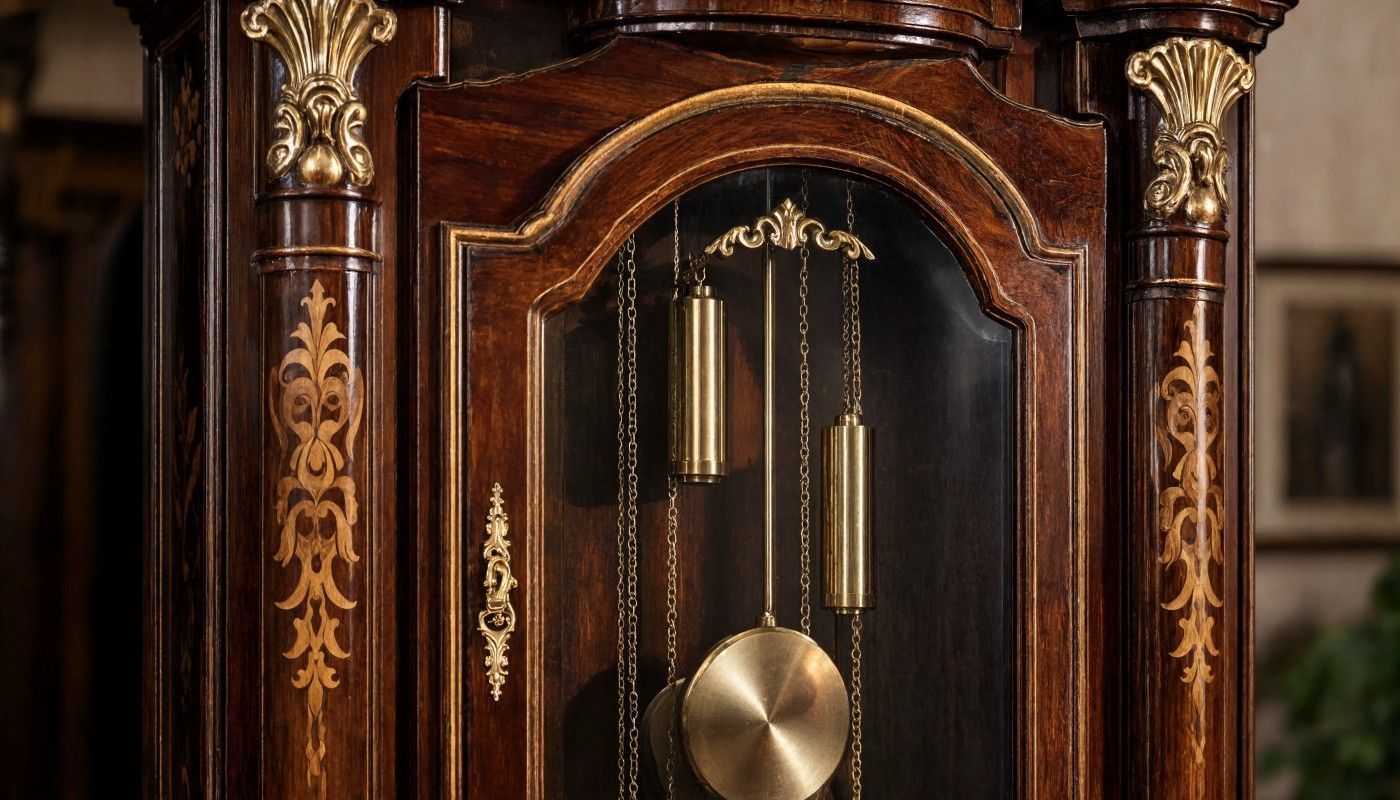
Mechanical clocks are usually powered by weights, springs, or a combination of systems.
Weight-Driven Movements
Weight-driven clocks use gravity to power the mechanism. They may have:
- Hanging weights
- Chains
- Cables
- Ropes
- Pulleys
- Drums
- Winding holes that raise the weights
Weight-driven construction is associated with many early domestic clocks, longcase clocks, regulators, wall clocks, and tower clocks. However, weight-driven clocks are still produced, so the presence of weights does not prove that a clock is antique.
Spring-Driven Movements
Spring-driven movements store energy in wound mainsprings. They allowed manufacturers to create more compact mantel, carriage, bracket, and wall clocks. Examine whether the spring is housed inside a barrel or exposed. Also note the number of winding points. A clock with multiple winding holes may have separate power trains for timekeeping, striking, and chiming. The design of these systems can help identify the movement family and manufacturing period.
Examine the Escapement
The escapement regulates the release of power through the movement. Different escapements were developed and adopted at different times.
Examples include:
- Verge escapements
- Anchor escapements
- Deadbeat escapements
- Recoil escapements
- Platform escapements
- Pin-pallet escapements
- Cylinder escapements
Identifying an escapement can help narrow the clock’s type and general era. For example, certain escapements are more strongly associated with early bracket clocks, precision regulators, carriage clocks, or inexpensive factory-made clocks.
An escapement may have been modified during a later repair. Look for unused holes, altered brackets, fresh metalwork, or components that do not match the surrounding mechanism.
Look at the Strike and Chime System
A clock’s sound mechanism can provide additional dating evidence. Antique clocks may strike a bell, gong, coiled rod, or set of chime rods.
Common systems include:
- Bell striking
- Single-gong striking
- Count-wheel striking
- Rack-and-snail striking
- Cathedral gong striking
- Quarter-hour chiming
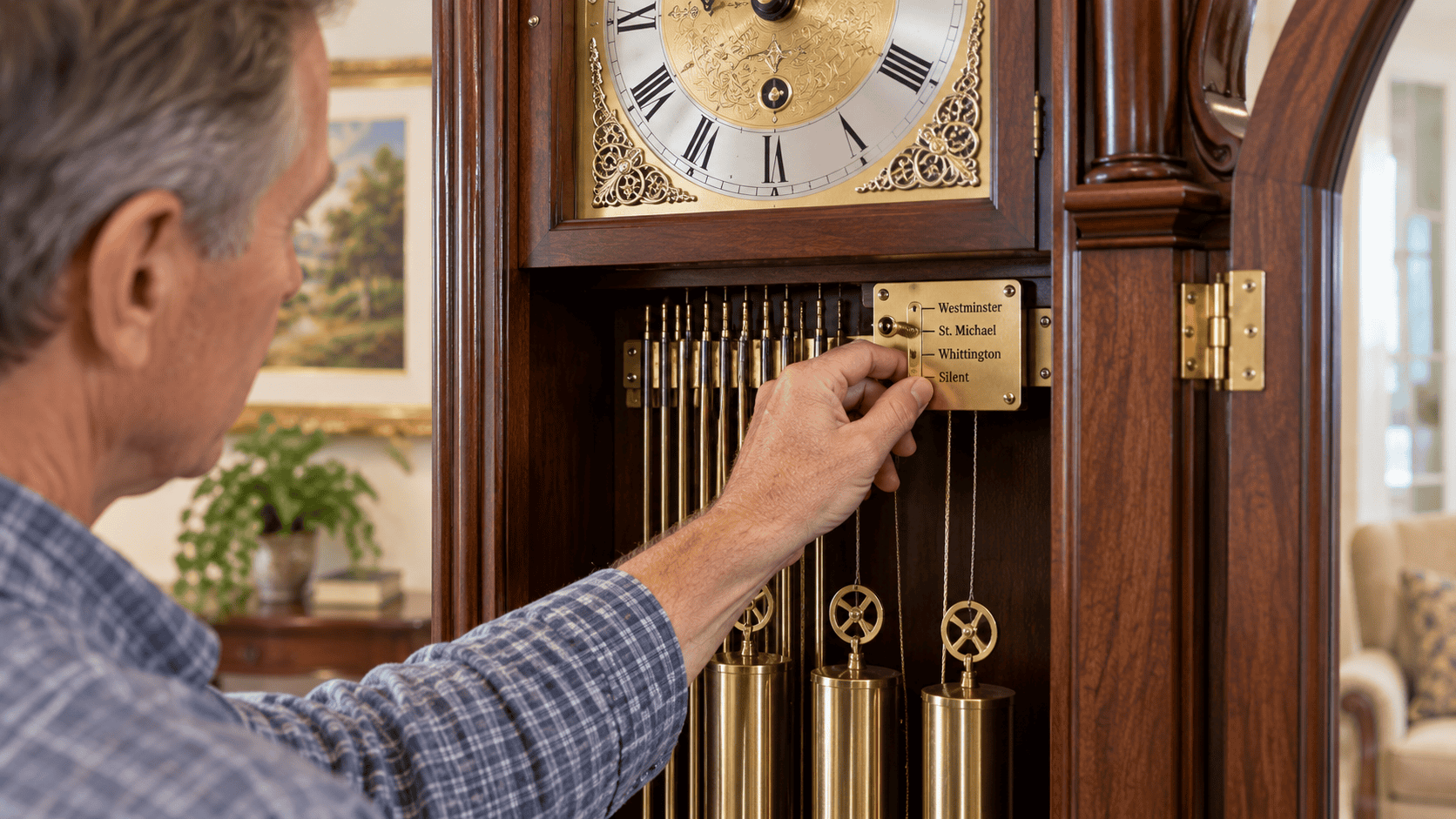
- Westminster chimes
- Musical movements
Count-wheel and rack-and-snail systems were both used for long periods, but their configuration can help identify a movement style. Gong shapes, hammer designs, chime sequences, and rod arrangements can also reflect manufacturing trends.
Check whether the gong base, bell, hammer, and movement appear to belong together. Extra screw holes or poorly aligned hammers may indicate that part of the sound system was replaced.
Consider Country-of-Origin Markings
Country-of-origin labels can establish an important boundary date. Marks such as “Germany,” “France,” “England,” or “Made in USA” may indicate the export market and the labeling practices in effect when the clock was sold.
Wording matters. A movement marked with a modern national designation may be later than a visually similar unmarked movement. Nevertheless, country markings should be interpreted carefully because:
- Export requirements changed over time
- Not every clock was intended for export
- Labels can fall off
- Cases and movements may come from different countries
- A retailer may have assembled imported and domestic components
A country name is most useful when combined with a manufacturer’s history and movement design.
Check Patent Dates and Registration Marks
Patent information can provide a useful earliest possible date. A clock containing a mechanism covered by a patent could not have been made before that patent was issued.
However, a patent date does not prove the clock was made during that exact year. Manufacturers sometimes continued using patent references for many years.
You may encounter:
- Patent dates
- Patent numbers
- Registered design numbers
- Trademark registration marks
- Model designations
- Exhibition award medallions
Research the full marking rather than focusing only on the visible year. An award date or patent date usually establishes a starting point, not a complete manufacturing date.
Compare the Movement With the Dial and Case
A movement date should make sense in relation to the rest of the clock.
Examine the case for:
- Wood species
- Veneer patterns
- Joinery methods
- Machine-cut or hand-cut dovetails
- Nail and screw types
- Decorative carvings
- Finishes
- Glass style
- Door and hinge construction
Examine the dial for:
- Painted or engraved numerals
- Enamel, brass, silvered, or paper surfaces
- Maker and retailer names
- Subsidiary dials
- Winding-hole placement
- Calendar displays
- Hand style
The winding holes should align naturally with the movement’s winding arbors. The pendulum should have enough clearance to swing correctly, and the strike components should align with the clock’s bell or gong.
Misaligned holes, added mounting blocks, or fresh screw holes can suggest that the movement was installed later.
Recognize Signs of a Marriage Clock
A “marriage” clock is assembled from components that were not originally manufactured or sold together. A marriage clock is not necessarily unattractive or mechanically poor, but it should not be represented as completely original.
Warning signs include:
- Movement mounting holes that do not align with older holes
- A dial that covers part of the movement
- Winding holes with rough or widened edges
- A movement that appears too small for the case
- Fresh wood around mounting points
- A pendulum that cannot swing freely
- A gong or bell that does not align with the hammer
- Different levels of wear among components
- Inconsistent manufacturing periods between the movement and case
Some alterations were practical repairs made generations ago. Documenting those changes is part of understanding the clock’s history.
Watch for Replacement Parts and Later Repairs
Most working antique clocks have received maintenance at some point. Replacement bushings, springs, suspension parts, hands, pendulums, and screws are common.
Evidence of repair may include:
- Newer screws among older hardware
- Bushings around worn pivot holes
- Solder repairs
- Replaced springs
- Scratched service dates
- Repair shop labels
- Fresh oil residue
- Modern suspension springs
- Newly manufactured gears
A repaired clock can still be historically important and valuable. The key is determining which components are original, which were replaced, and whether the work preserved the movement’s basic design.
Create a Date Range Instead of Choosing One Year
Unless the movement has a documented serial number, factory record, or dated inscription, it is usually more accurate to establish a range than to name one exact year.
A strong dating conclusion might combine several observations:
- The manufacturer operated during a known period
- The logo was used within a narrower portion of that period
- The movement’s construction matches documented examples
- A patent date establishes the earliest possible production year
- The case style is consistent with the proposed date
- The dial and movement appear to be original to each other
Based on that evidence, the clock might reasonably be described as “circa 1880 to 1890” rather than “made in 1885.”
The term “circa” indicates that the date is approximate. Use it only when the evidence supports a reasonable range.
Common Mistakes to Avoid
When researching how to date an antique clock by its movement, avoid relying on a single feature.
Common errors include:
- Treating every number as a serial number
- Assuming a patent date is the manufacturing date
- Dating the entire clock from the case style alone
- Assuming the dial name identifies the movement maker
- Believing all handmade-looking parts are early
- Ignoring evidence of a replacement movement
- Cleaning away marks before documenting them
- Forcing the movement out of the case
- Using online listings as the only reference
- Assuming an old clock is valuable solely because of its age
Online marketplace descriptions can offer leads, but seller dates are not always supported by research. Museum collections, manufacturer catalogs, archival advertisements, specialist books, and professional evaluations are generally more dependable.
When to Consult a Professional Clock Specialist
Professional assistance is particularly valuable when:
- The clock may be rare or historically significant
- The movement has no obvious maker’s mark
- The clock contains several mismatched components
- The mechanism is damaged or heavily corroded
- The movement must be removed for identification
- You are considering restoration
- You need documentation for insurance or estate purposes
- The clock has substantial financial or sentimental value
Avoid running a dry, dirty, or damaged movement simply to test it. Hardened oil, worn pivots, and misaligned components can cause additional damage. A trained clock specialist can inspect the movement without unnecessary disassembly and explain which findings are relevant to dating.
Frequently Asked Questions
Can you date an antique clock using only the movement?
You can often estimate a date range from the movement, but the result is stronger when you also examine the case, dial, hardware, pendulum, and documented history.
Where can I find the movement number on an antique clock?
Movement numbers are commonly stamped on the back plate. They may also appear on the front plate behind the dial, along the plate’s edge, or on another internal component.
Is the number stamped on a clock movement always a serial number?
No. It may be a model, batch, patent, parts, or assembly number. Confirm its purpose using records from the correct manufacturer.
Does a patent date show when the clock was made?
Not necessarily. It establishes that the clock was made no earlier than the patent date, but the design may have remained in production for years.
What does “circa” mean when dating an antique clock?
“Circa” means approximately. A clock described as circa 1890 was likely made near that year, but the exact date has not been confirmed.
Can an antique case contain a newer movement?
Yes. Movements were sometimes replaced when repairs became difficult or expensive. Mounting holes, winding-hole alignment, and differences in wear can reveal a replacement.
Does restoration reduce an antique clock’s value?
It depends on the clock and the quality of the work. Sensitive repairs that preserve original material may support usability, while excessive refinishing or poorly matched replacement parts can reduce collector interest.
Should I clean an antique clock movement myself?
Surface dust can sometimes be addressed cautiously, but internal cleaning and lubrication should generally be handled by a trained clock technician. Household oils and improper cleaning methods can damage the movement.
How accurate is movement-based dating?
Accuracy depends on the available evidence. A documented serial number may produce a narrow date, while an unmarked or altered movement may support only a broad period.
Are all weight-driven clocks antique?
No. Weight-driven clocks are still manufactured. The power source must be evaluated alongside construction, markings, materials, and design.
Trust Chicago Clock Company With Your Timepiece
Dating an antique clock requires careful observation, reliable research, and an understanding of historical clockmaking methods. When a timepiece is especially valuable, fragile, or personally meaningful, professional inspection can help protect it while revealing more about its construction and history.
We have served generations of clock owners since 1917 and provide professional clock inspection, maintenance, and repair services. Our technicians evaluate movements carefully, clean and lubricate mechanical components, test performance, and help preserve treasured timepieces. We also offer in-home grandfather clock repair and operate locations in Clarendon Hills, Orland Park, and Palatine.
Do not risk damaging an antique movement through forced disassembly, improper oiling, or guesswork. Contact us to learn more about professional clock services, request expert assistance, or find a convenient location near you.